In the Middle East, a few days can sometimes bring into focus geopolitical changes that have been taking shape for months.
On September 24, Benjamin Netanyahu used the podium at the United Nations General Assembly to directly target President Recep Tayyip Erdoğan. He accused Türkiye of hosting Hamas leaders and adopted unusually harsh language toward Ankara. This was more than another episode in the war of words over Gaza. Netanyahu placed Türkiye within a much broader regional threat narrative.
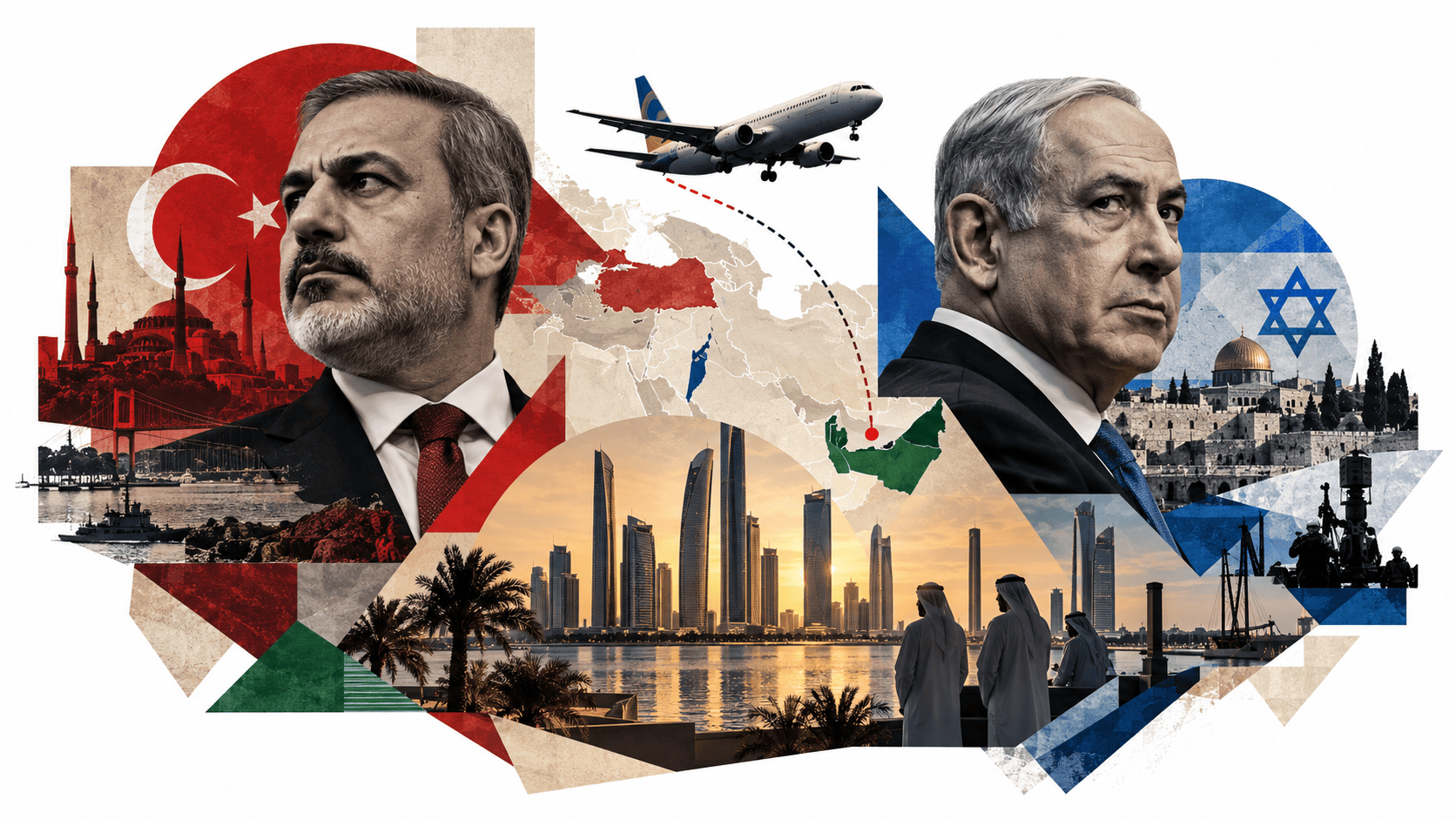
Three days later, he was in Abu Dhabi.
According to the Israeli Prime Minister’s Office, the September 27 visit took place at the invitation of UAE President Sheikh Mohammed bin Zayed. Netanyahu was accompanied by some of the most senior figures in Israel’s security establishment, including the head of the National Security Council, the Mossad chief and his military secretary.
The Emirati side said the talks focused on bilateral relations and regional developments. Three senior Israeli officials, however, told Reuters that Iran was at the heart of the six-hour discussions.
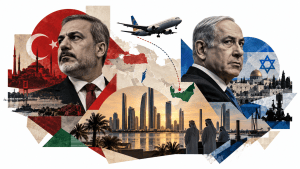
The following day, September 28, it was Hakan Fidan’s turn to visit Abu Dhabi.
Fidan met not only with Mohammed bin Zayed, but also with Vice President Mansour bin Zayed and National Security Adviser Tahnoun bin Zayed, one of the most influential figures in the UAE’s security architecture.
The Turkish side said discussions focused on bilateral ties, regional developments and the need to strengthen regional solidarity. There is no evidence that Fidan’s visit was arranged in response to Netanyahu’s presence; Ankara had already announced the trip on September 27.
Yet the fact that senior Israeli and Turkish foreign policy and security figures were in the same capital within 24 hours was significant in itself. It underscored Abu Dhabi’s growing role in the region’s emerging balance of power.
Then the rhetoric from Israel hardened further.
On September 29, speaking at Tel Nof Air Base, Netanyahu said: “There are signs that our enemies may try to attack us before the elections.”
He added: “Do not mess with us, not now and not ever. Our long arm will reach you anywhere and at any time.”
Netanyahu did not identify any country or organization. Israeli opposition leader Yair Lapid subsequently demanded a security briefing, arguing that such threats should not become part of an election campaign.
A day later, attention across the region turned to Flydubai flight FZ1073 from Dubai to Tel Aviv.
Türkiye Is No Longer Just a Diplomatic Rival for Israel
For Türkiye, the most important aspect of these developments lies beyond what exactly happened aboard the Flydubai flight.
The broader trend is more consequential.
Judging by statements and moves from the Netanyahu government in recent months, Türkiye is no longer being portrayed simply as one of the countries criticizing Israel’s war in Gaza. Ankara is increasingly being drawn into Israel’s wider struggle over security, law and regional influence.
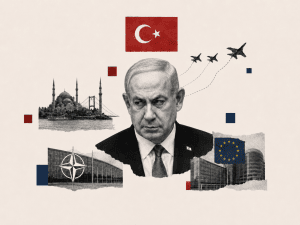
One of the clearest examples came on September 27, when i24NEWS reported that Netanyahu had instructed an interministerial team and Israel’s International Law Department to begin preparing a possible case against Erdoğan at the International Criminal Court.
According to the report, the file would focus on allegations concerning the Kurds and Hamas. Israeli sources were also quoted as saying that the primary purpose was not necessarily to pursue immediate legal action, but to create a form of deterrent pressure on Ankara.
Neither Netanyahu nor Israel’s Justice Ministry commented on the report. At this stage, therefore, no formal ICC case has been opened.
That distinction matters.
What is emerging is no longer merely a rhetorical confrontation between Erdoğan and Netanyahu. In Israel, a broader approach is being discussed in which diplomatic, legal and security instruments could potentially be used together against Türkiye.
And the dispute is no longer confined to Gaza.
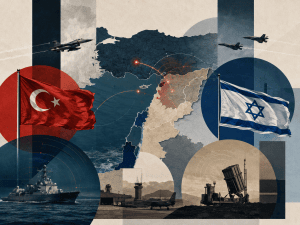
Reuters reported in July that Israel was lobbying Washington against the possibility of Türkiye regaining access to the F-35 program. In August, it also emerged that the United States was working on a new deconfliction mechanism designed to prevent an unintended military confrontation between Türkiye and Israel in Syria.
U.S. Special Envoy for Syria Tom Barrack said openly that Türkiye had not been warned in advance of one Israeli strike and that Ankara preparing for a possible military response could therefore be understandable.
In other words, the Ankara-Tel Aviv confrontation can no longer be reduced to the Palestinian issue.
The future of Syria, the military balance in the Eastern Mediterranean, access to U.S. weapons systems, Hamas and the question of which security architecture the Gulf states will gravitate toward are increasingly becoming different parts of the same strategic equation.
This is precisely why Netanyahu’s and Fidan’s back-to-back visits to the UAE matter.
Israel is seeking to preserve the security relationships it has built with the Gulf through the shared focus on Iran. Türkiye, meanwhile, has emphasized a different principle in its rapidly expanding relations with Gulf capitals: greater regional ownership.
Ahead of Fidan’s visit, Turkish diplomatic sources explicitly said that Ankara would stress the view that outside interventions tend to prolong and deepen regional crises.
In that sense, Abu Dhabi was not simply hosting two unrelated diplomatic visits. It also provided a glimpse of two different approaches to the future security order of the Middle East.
And it was against this backdrop that the Flydubai incident occurred.
On September 30, a serious act of violence took place in the cockpit of a Dubai-Tel Aviv flight.
According to Netanyahu and Israeli officials, the co-pilot stabbed the captain and attempted to bring down the aircraft. The suspect was reportedly subdued after passengers and other pilots intervened, and the aircraft was safely diverted to Tabuk in Saudi Arabia.
Flight-tracking data indicated that the aircraft lost roughly 14,000 feet of altitude in a very short period. The suspect was detained by Saudi authorities.
But an important distinction is necessary.
The motive behind the incident has not yet been established. Israeli authorities are investigating the possibility of terrorism, while Netanyahu has described the event as an attempt to bring down the plane. Flydubai, for its part, has warned against speculation before the investigation is complete.
There is also no evidence at this stage linking Türkiye to the incident.
Its political impact, however, could prove broader than the attacker’s eventual motive.
The episode came just one day after Netanyahu warned that Israel’s enemies might be preparing an attack. A security crisis of this magnitude could therefore reinforce an already expanding threat narrative inside Israel.
Another statement made on September 29 is also worth watching. Israeli Defense Minister Israel Katz said that Hamas leaders abroad remained potential targets.
Given that Netanyahu’s government has repeatedly accused Türkiye of hosting Hamas figures, the overlap between these two narratives is something Ankara will be watching closely.
For now, Israel’s struggle with Türkiye does not appear to be moving toward direct military confrontation. Rather, it resembles an increasingly multilayered competition fought through perceptions, legal pressure, diplomacy, defense relationships and regional alliances.
Netanyahu’s remarks at the United Nations, reports of a potential ICC case against Erdoğan, Israel’s opposition to Türkiye’s return to the F-35 program and the growing proximity of Turkish and Israeli military spheres of influence in Syria all point in the same direction.
The next place to watch, therefore, may be not Ankara or Tel Aviv, but the Gulf capitals.
The UAE has maintained close ties with Israel since the 2020 Abraham Accords. At the same time, it has become one of Türkiye’s most important trade partners in the Gulf.
Saudi Arabia, meanwhile, reportedly rejected an Israeli request to send military aircraft to collect passengers stranded after the Flydubai incident. Riyadh also continues to insist that normalization with Israel would require tangible progress toward Palestinian statehood.
This suggests that the Gulf states have little interest in making a simple choice between Israel and Türkiye. Instead, they are seeking to preserve as much strategic room for manoeuvre as possible between Washington, Tel Aviv, Ankara and even Tehran.
The key question raised by the Flydubai incident, then, will not simply be who was behind the attempted attack.
The larger question is where Türkiye will ultimately be placed within Israel’s expanding definition of “enemy” and “threat”, and how far the Gulf states will allow this new Türkiye-Israel rivalry to shape their own regional choices.
Perhaps the most important message of the past 72 hours is therefore this:
Türkiye–Israel tensions are no longer merely a bilateral diplomatic crisis. They are becoming part of a much broader regional contest for influence stretching from Syria to the Gulf, from Washington to the Eastern Mediterranean.