
Missiles striking airports and drones targeting energy infrastructure threaten not only Saudi Arabia’s security but also its economic ambitions. For Riyadh, stopping the attacks is an urgent priority. Yet who provides that protection—and what political relationship emerges in return—could have consequences far beyond the technical details of air defense.
This is where Netanyahu’s latest initiative comes into focus. According to diplomatic sources cited by Haaretz, Israel offered, through the United States, to join operations against the Houthis. Mohammed bin Salman reportedly rejected the proposal out of concern over a backlash from the Saudi public.
The political logic for Netanyahu is clear: security cooperation against a shared threat could help overcome obstacles to a diplomatic agreement. A rapprochement stalled over the Palestinian question could thus return to the agenda through Saudi Arabia’s immediate defense needs. Bin Salman’s reported refusal, however, signals that even Riyadh’s need for protection will not lead it to normalize relations with Israel or sign the Abraham Accords.
From External Dependence to Collective Security
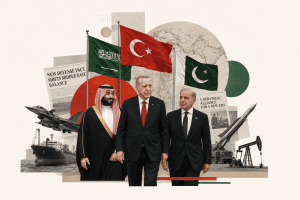
This is precisely what gives the Mecca Alliance its strategic significance. The partnership between Türkiye, Pakistan and Saudi Arabia offers an opportunity to reduce regional states’ reliance on security guarantees from outside powers. It also takes the rapprochement between Ankara and Riyadh beyond the repair of diplomatic ties and into a new phase of shared responsibility.
A commitment to protect a country, however, does not amount to a commitment to join every war it fights. Hakan Fidan’s statement that Türkiye will not take part in offensive operations, alongside Pakistan’s declaration that its forces will not enter Yemen to attack the Houthis, underscores that distinction. The stated objective is to strengthen Saudi Arabia’s defenses. The alliance’s success will hinge on its ability to protect Riyadh without drawing its members into an open-ended war in Yemen.
Türkiye’s historical ties with Yemen suggest that Ankara could play a meaningful role in the search for peace. Its most valuable contribution may be to complement defensive assistance with diplomatic efforts capable of bringing Yemen’s different actors to the negotiating table. Facilitating humanitarian access, supporting a ceasefire and backing UN-led negotiations would allow the security of the Yemeni people and that of Saudi Arabia to be addressed together.
For that to happen, the alliance must avoid becoming a vehicle for sectarian conflict. Its founding members’ stated commitments to collective defense and peaceful conflict resolution offer a framework broader than confrontation with any single state. Iran’s support for the Houthis does not mean that Tehran makes every decision on their behalf. An approach that disregards Yemen’s own political dynamics may deliver military gains, but it cannot produce lasting peace.
Egypt’s announcement on October 13 that it was seriously considering membership points to the partnership’s potential for expansion. A broader membership could bring diplomatic weight as well as additional military capabilities.
Trump’s favorable response to Turkish and Pakistani support for Saudi Arabia suggests that Washington does not, for now, view the alliance as wholly opposed to its interests. But sharing the United States’ security burden and strengthening regional states’ ability to make independent decisions are not the same thing. As the Mecca Alliance matures, the gap between those two expectations may become more apparent.
The next phase of this rivalry should therefore not be sought in Yemen alone. Israel’s relations with Somaliland and the United Arab Emirates’ activities in Berbera draw attention to the opposite shore of the Bab el-Mandeb Strait. Abu Dhabi’s partnerships within Yemen also show that the Gulf states’ interests are far from fully aligned.
Israel will seek to weaken a partnership that could constrain its room for maneuver. Yet the Mecca Alliance’s most important test will be its ability to manage differences among its own members before it can withstand pressure from outside. Regional autonomy is not secured by signing an agreement. It is earned through the ability to make joint decisions when a crisis strikes.