Three developments this week deserve particular attention.
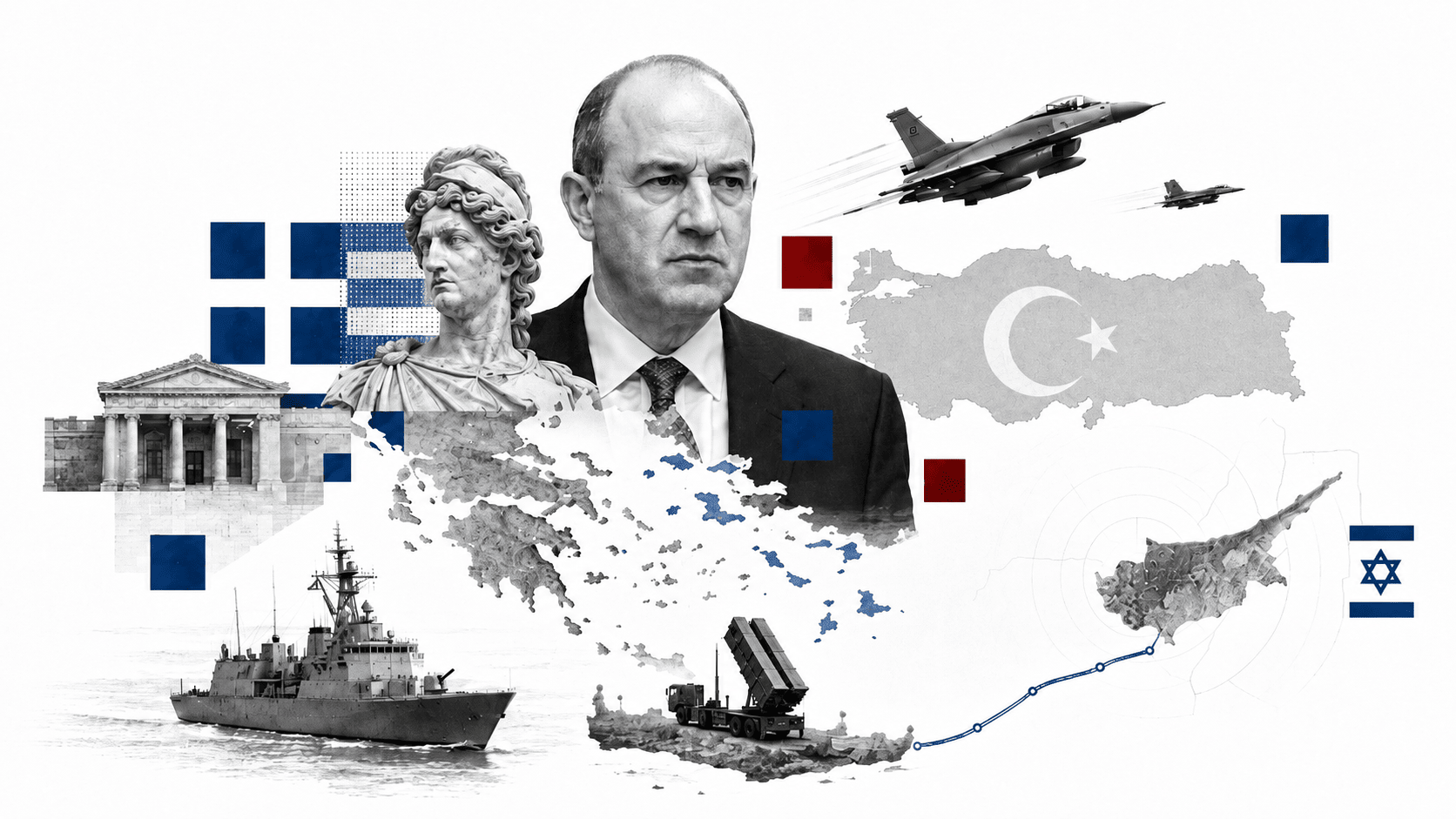
First, Israel struck Syria’s Abu al-Duhur airbase, claiming that Turkish forces could potentially be deployed there. Soon afterwards, Greece’s Chief of the Hellenic National Defence General Staff, Gen. Dimitrios Choupis, travelled to Israel, where he met his Israeli counterpart, Lt. Gen. Eyal Zamir, as well as senior officials at the Israeli Ministry of Defence. From Israel, Choupis went directly to Cyprus.
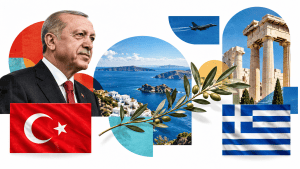
A few days later, Greek Foreign Minister George Gerapetritis appeared before the cameras and, when discussing the prospect of a new maritime confrontation with Türkiye, declared that “Greece is no longer standing by. It is taking action.”
What followed was even more explicit. Gerapetritis said that if Türkiye attempted to obstruct maritime surveys for the planned electricity interconnector between Cyprus and Crete, Greece could deploy frigates, use its F-16s if necessary and, from next year, bring its F-35s into the equation.
These developments cannot be viewed in isolation.
Athens has been steadily reshaping its strategy toward Türkiye. It is not only rearming at a rapid pace; it is also seeking to embed the bilateral balance of power within a broader security architecture built around the United States, France, Israel and the Greek Cypriot administration.
To understand the growing confidence behind Greece’s increasingly forceful rhetoric, it is first necessary to recall just how many disputes remain unresolved in the Aegean.
There Is No Single Aegean Dispute
The first disagreement between Ankara and Athens concerns the very definition of the dispute itself.
Greece maintains that the principal issue to be resolved with Türkiye is the delimitation of the continental shelf and exclusive economic zones. Türkiye sees a much broader and interconnected set of disputes: the continental shelf, maritime jurisdiction zones, the breadth of territorial waters, national airspace, the sovereignty of certain islands, islets and rocks, the militarisation of the eastern Aegean islands, as well as flight information region and search-and-rescue responsibilities.
These may sound like technical differences. In reality, they lie at the heart of the rivalry between the two countries.
Greece, for example, argues that it has the right to extend its territorial waters in the Aegean from the current six nautical miles to 12. Türkiye counters that the Aegean’s unique geography makes such an extension fundamentally different from an ordinary application of maritime law, because it would dramatically alter the balance of access and jurisdiction across the sea.
According to Ankara’s calculations, extending Greek territorial waters to 12 nautical miles would place more than 70 percent of the Aegean under Greek sovereignty, while reducing international waters to roughly 19 percent. This is why the Turkish parliament’s 1995 resolution on the issue continues to carry considerable political weight in Ankara.
There is a similar dispute over airspace. Greece claims ten nautical miles of national airspace in the Aegean while maintaining territorial waters of six nautical miles. Türkiye does not recognise the additional four-mile zone.
The sovereignty of islands, islets and rocks represents another major fault line.
The 1996 Imia/Kardak crisis, which brought the two countries to the brink of war, remains the best-known example. Türkiye argues that a number of islands, islets and rocks in the Aegean were never explicitly ceded to Greece under international treaties. Athens rejects Ankara’s “grey zones” argument and insists that sovereignty over these geographical formations is not in question.
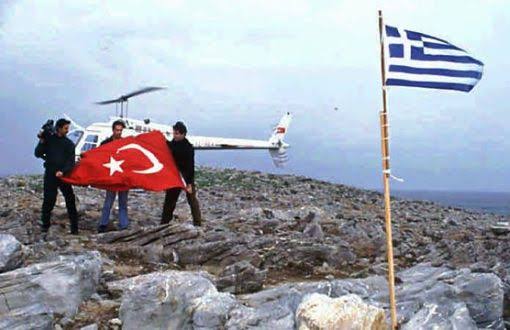
These rocks are not insignificant dots on a map.
Sovereignty over even a tiny piece of land can affect the territorial waters surrounding it and, in some cases, the delimitation of broader maritime zones. The UN Convention on the Law of the Sea itself distinguishes between islands and rocks that cannot sustain human habitation or an economic life of their own. The latter are not entitled to an exclusive economic zone or continental shelf.
That is why even an uninhabited rock measuring only a few hundred metres can become part of a much larger dispute over sovereignty and maritime jurisdiction in the Aegean.
The militarisation of the islands adds another layer of tension.
Article 13 of the Treaty of Lausanne imposes restrictions on military installations and forces on Lesbos, Chios, Samos and Ikaria. The 1947 Paris Peace Treaty contains an explicit demilitarisation provision concerning the Dodecanese. Ankara and Athens also interpret the legal consequences of the Montreux Convention differently with regard to Lemnos and Samothrace.
Türkiye argues that Greece has militarised these islands in violation of its treaty obligations. Athens invokes Türkiye’s military presence along the Aegean coast, Ankara’s 1995 casus belli declaration over the 12-mile issue and broader security concerns to justify the deployments as measures of self-defence.
What is striking today is that the Greek government no longer appears reluctant to advertise the strengthening of the islands’ defences. Speaking in Rhodes in March, Gerapetritis stated openly that Greece had “strengthened the defence of our islands” and suggested that the policy would not be reversed.
At the same time, Athens is pursuing one of the most ambitious military modernisation programmes in its recent history. Its F-16 fleet is being upgraded, its Rafale force expanded, Belharra-class frigates are joining the navy and preparations for the acquisition of F-35s are moving ahead. Greece plans to spend roughly €28 billion on defence modernisation through 2036.
A New Greece-Israel Military Axis
Israel is no longer merely an arms supplier in Greece’s military build-up. The relationship is evolving into a durable defence partnership spanning joint exercises, technology, pilot training, cyber security and advanced weapons systems.
One of the clearest signs of this shift is the military cooperation programme planned for 2026. According to Greek Defence Minister Nikos Dendias, the two countries intend to conduct 54 joint activities this year alone — 29 in Greece and 25 in Israel.
The programme goes well beyond conventional joint training and interoperability. It encompasses emerging areas of warfare such as counter-drone operations, unmanned maritime systems, cyber threats, defence technologies and military innovation.
Another important pillar of the relationship is the International Flight Training Centre in Kalamata, which is operated by Israel’s Elbit Systems and plays a significant role in the training infrastructure of the Hellenic Air Force. Israeli technology is therefore shaping not only the missile and radar systems Greece buys, but also the training of the pilots who will operate Greece’s future combat aircraft.
Arms procurement remains the most visible dimension of the relationship.
In July, Athens moved ahead with plans for a new multi-layered air-defence architecture, known as the “Achilles Shield”, worth approximately €3.5 billion. Israeli systems developed by Rafael and Israel Aerospace Industries are expected to form key components of the network.
Greece has already incorporated Israeli-made Heron unmanned aerial vehicles into its arsenal and has also moved toward the acquisition of 36 PULS rocket artillery systems. A growing share of Athens’ €28 billion military modernisation programme through 2036 is therefore becoming intertwined with Israel’s defence industry.
Yet the significance of the relationship extends well beyond procurement.
Greece, Israel and the Greek Cypriot administration have also signed a joint military action plan for 2026. It provides for joint operational activities, special-forces training and regular contacts between their respective military staffs. Expanded air and naval exercises in the Eastern Mediterranean are also part of the framework.
What began as a diplomatic trilateral format is gradually acquiring a much more tangible military dimension.
For Türkiye, this evolution matters.
For years, Athens built much of its external security architecture around its relationships with the United States and France. Israel is now being added to that network in an increasingly significant way — not simply as an arms supplier, but as a partner that trains with the Greek military, shares technology and participates in a trilateral military framework that also includes the Greek Cypriot administration.
Some of Athens’ newfound confidence appears to stem from precisely this expanding network.
The relocation of a Patriot air-defence battery from the island of Karpathos to Souda Bay in Crete adds another element to the growing military concentration in the Eastern Mediterranean. The official explanation is the need to protect strategically important US and NATO facilities against potential threats from Iran.
Yet whatever its immediate rationale, the deployment also underlines Crete’s growing importance in the regional security architecture and Souda Bay’s emergence as an increasingly significant military hub.
And this brings the debate to its most uncomfortable question: with the heavy price paid by Ukraine after placing its faith in Western support, could Greece, convinced that Israel and its other allies would stand behind it, be tempted into a similarly dangerous strategic gamble against Türkiye?