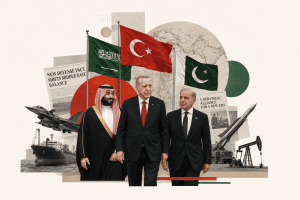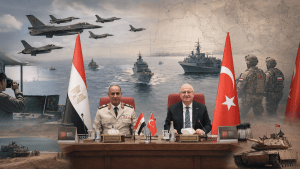
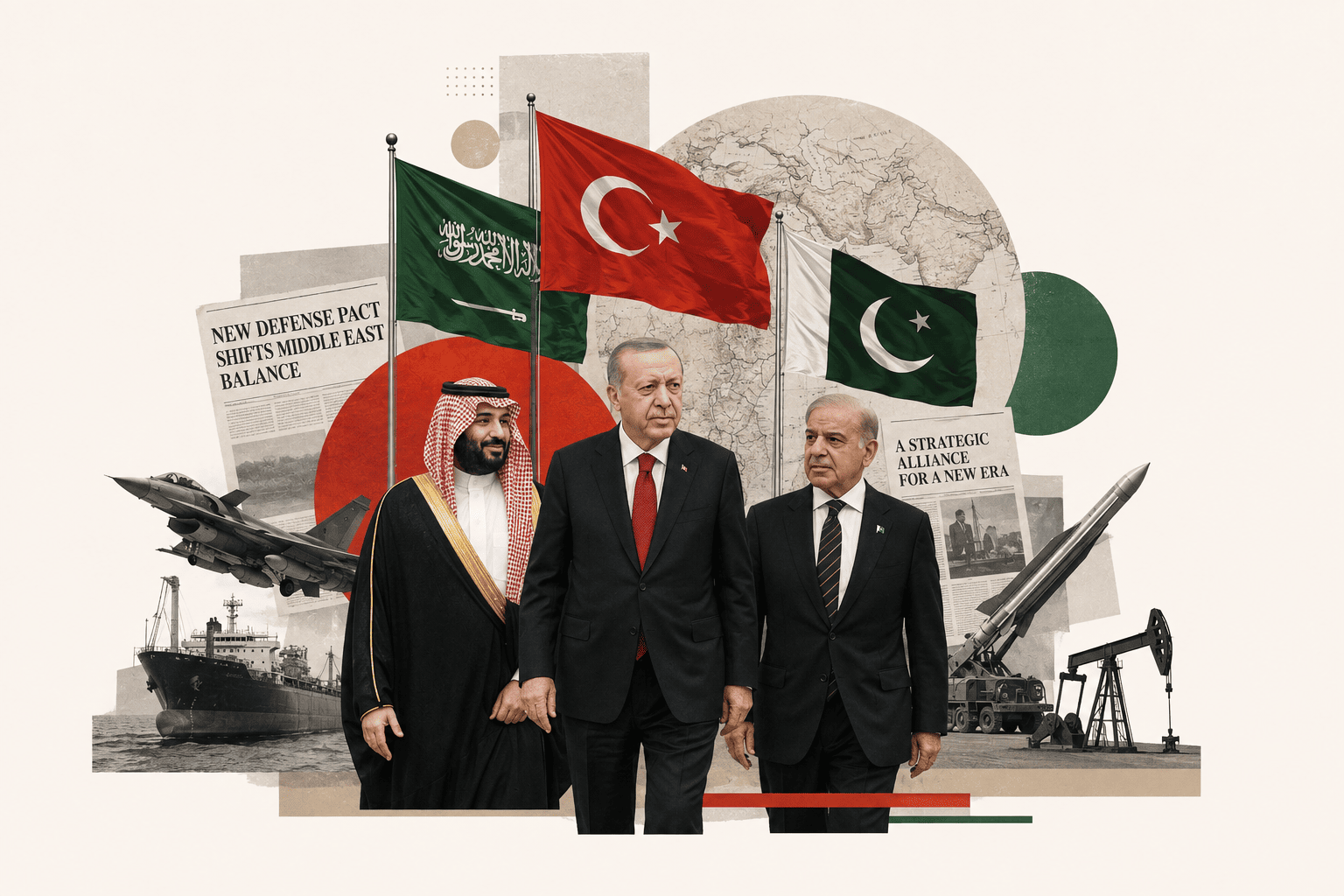

The Mecca Collective Defense Agreement, signed by Türkiye, Saudi Arabia and Pakistan on August 7, was immediately portrayed by the international press as one of the most significant developments in the Middle East’s evolving security architecture. The agreement stipulates that an attack on any one of the three countries will be considered an attack on the others, a provision widely compared in the media to NATO’s principle of collective defense. Yet international coverage has focused on something even more consequential: the potential regional implications of bringing Türkiye’s military capabilities, Pakistan’s nuclear deterrent and Saudi Arabia’s economic power together within a single security framework.
Reuters framed the agreement as part of a broader search for security prompted by the upheavals that have shaken the Middle East in recent years. The war with Iran, attacks against Gulf states and the conflict in Yemen have led Riyadh to reassess the adequacy of the existing security order, while its long-standing military ties with Ankara and Islamabad have, for the first time, evolved into a framework based on the principle of collective defense.
One point highlighted by experts speaking to Reuters was that the agreement cannot be understood solely through the prism of the Iranian threat. Israel’s increasingly assertive military posture in recent years has also emerged as an important factor shaping how Türkiye, Saudi Arabia and Pakistan perceive the regional security environment.
The British newspaper The Guardian, meanwhile, described the agreement explicitly as a “NATO-style defense pact.” The choice of words is significant. The framework established in Mecca does not yet possess NATO-like joint command structures, institutionalized military bodies or detailed intervention procedures. Nevertheless, the principle that “an attack on one will be considered an attack on all” indicates that the agreement goes far beyond conventional defense cooperation. While The Guardian emphasized the war with Iran and Houthi attacks, it also noted that the pact comes at a time when Middle Eastern states are increasingly seeking to take greater responsibility for organizing their own security.
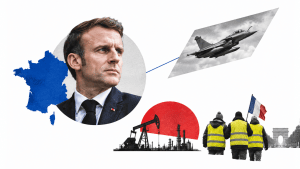
Similarly, the French newspaper Le Monde assessed the agreement against the backdrop of the Iran war and attacks launched from Yemen against Saudi Arabia. Its use of the term “collective security” effectively captures the broader tone of international coverage. The significance of the Mecca Agreement lies not merely in deepening military cooperation between Türkiye, Pakistan and Saudi Arabia, but in the fact that the three countries have effectively declared that their security can no longer be considered in isolation from one another.
Germany’s Die Zeit adopted a more cautious approach, focusing in particular on the relationship between Türkiye’s NATO membership and the new defense agreement. According to Ankara, the Mecca Agreement does not conflict with Türkiye’s NATO obligations and is not directed against any third country. That this issue has featured prominently in the German press is hardly surprising. Türkiye is now simultaneously part of NATO’s collective defense system and a separate collective security mechanism involving two major Muslim countries outside the Alliance.
Chinese media raised a different question: what does this mean for the future of the American security umbrella? The South China Morning Post interpreted the rapprochement between Türkiye, Pakistan and Saudi Arabia not only through the lens of regional conflicts, but also as part of Riyadh’s effort to diversify its security partnerships. This points to perhaps one of the Mecca Agreement’s most important long-term dimensions. For decades, Saudi Arabia has relied heavily on its strategic relationship with the United States for its security. The new agreement does not replace Washington, but it does create an additional security pillar that could serve as an alternative.
An analysis published by Al Jazeera focused on precisely this question: what does the Mecca Agreement mean for the United States’ role in the Middle East? According to experts cited in the report, regional states are not seeking to sever their ties with Washington, but neither do they want to entrust their security exclusively to American guarantees. The emerging picture therefore points less to a break with the United States than to the search for a more autonomous regional order based on diversified security partnerships.
At this point, interpretations in the international press begin to diverge. While much of the Western media views the agreement through the transformation of the US-led security order and the war with Iran, Israeli and Indian media have focused on a very different set of concerns.
From Israel to India: Unease Over the New Alliance
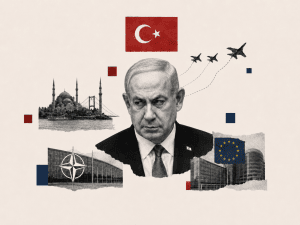
One of the most striking assessments of the agreement appeared in Israel’s Ynet. Yoel Guzansky, a former official at Israel’s National Security Council who heads the Gulf Program at the Institute for National Security Studies, rejects the idea that the framework created in Mecca should be viewed solely as a security mechanism directed against Iran. According to Guzansky, the agreement is also “an alliance aimed at balancing Israel’s power.”
The Israeli expert makes a second, even more important distinction. He does not regard the Mecca Agreement as a military alliance created specifically to wage war against Israel, but he does consider its broader strategic orientation unfavorable from Israel’s perspective.
At the heart of this concern lies Saudi Arabia rather than Türkiye or Pakistan. One of the central objectives of Israel’s regional strategy in recent years has been to normalize relations with Riyadh within the framework of the Abraham Accords and draw Saudi Arabia into a new security architecture linking Israel with Arab states. The Mecca Agreement offers Riyadh a different option: rather than joining a regional security order structured around Israel, Saudi Arabia can build a separate security axis with Türkiye and Pakistan.
Commentary published in The Times of Israel has also highlighted this point. The diversification of Saudi Arabia’s security options could complicate not only Israeli-Saudi relations, but also Washington’s broader objective of bringing Israel and the Gulf states together within a common security architecture.
In India, by contrast, the debate centers on Pakistan. The Indian Express examined the agreement through the question, “An Islamic NATO?”, placing particular emphasis on Pakistan’s status as a nuclear-armed state. From New Delhi’s perspective, the central question is clear: if a future military crisis were to erupt between India and Pakistan, would it fall under the principle that “an attack on Pakistan is an attack on all three countries”?
There is no definitive answer to this question yet. The publicly disclosed provisions of the agreement do not indicate that Pakistan’s nuclear arsenal has been incorporated into a joint deterrence system extending to Türkiye or Saudi Arabia. Nor has any detailed mechanism been announced that would automatically require the parties to intervene militarily in the event of a crisis. It would therefore be premature to describe the Mecca Agreement as a “nuclear umbrella.”
Nevertheless, it is clear that New Delhi is watching the agreement closely. India’s Ministry of External Affairs has said that it is monitoring the implications of the development for national security and the regional balance of power. Reports that India was seeking a countervailing defense pact with Israel emerged shortly after the agreement was signed, illustrating the degree of sensitivity surrounding the issue. New Delhi explicitly denied the claim, stating that the report was fabricated content generated by artificial intelligence.
The Iranian media have adopted an entirely different perspective. While acknowledging the combined weight of Türkiye and Pakistan’s military capabilities and Saudi Arabia’s financial power, the Tehran Times portrayed the agreement as evidence of Riyadh’s “strategic panic” and structural security vulnerabilities. According to the Iranian outlet, Saudi Arabia’s efforts to establish new external security mechanisms will not resolve the country’s underlying security problems. This rhetoric illustrates just how differently Tehran views the Mecca Agreement: while Western media speak of an emerging regional security architecture, Iranian media portray it as a sign of Saudi weakness.
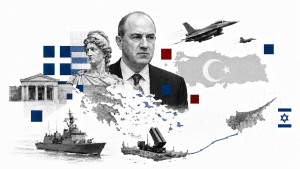
The Greek press has also closely followed the agreement’s strategic significance for Türkiye. Kathimerini highlighted Ankara’s insistence that the agreement is not directed against any third country, while also raising questions about the relationship between Türkiye’s NATO membership and the new mechanism. From Athens’ perspective, the central concern is that Türkiye’s relationship with Saudi Arabia has now moved beyond economic and diplomatic rapprochement into the realm of collective defense. Given Greece’s efforts in recent years to deepen its ties with Israel and the Gulf states partly within the context of its strategic competition with Türkiye, Ankara’s new partnership with Riyadh could also affect Athens’ regional calculations.
Yet perhaps the most striking common thread running through all these interpretations is that there is still no single answer to the question of whom the agreement is actually directed against.
Iran is wary of a new security axis that could potentially be turned against it. Some Israeli security experts see the agreement as an attempt to balance Israel’s regional power. India is calculating what Pakistan’s new partners could mean for its own security. Western media, meanwhile, interpret the same development as a sign of a gradual shift away from a US-centered security order toward a more autonomous Middle East.
The scale of the international reaction to the Mecca Agreement stems precisely from this ambiguity. The mechanics of its military implementation remain unclear. Yet the fact that countries across the world have already begun debating the same agreement through the prism of their own security calculations demonstrates the significance of what was signed in Mecca.
It may therefore be too early to declare that an “Islamic NATO” has been created. But international commentary broadly converges on one point: bringing Türkiye, Saudi Arabia and Pakistan into the same security equation has introduced a new variable into the Middle East’s balance of power, one whose full implications are still difficult to predict.
Perhaps this is where the true significance of the Mecca Agreement lies. More important than the question of whom it is directed against is the fact that, in the wake of its signing, countries from Israel to India and from Iran to Europe have begun reassessing their own strategic calculations. This suggests that the region’s security architecture may never look quite the same again.