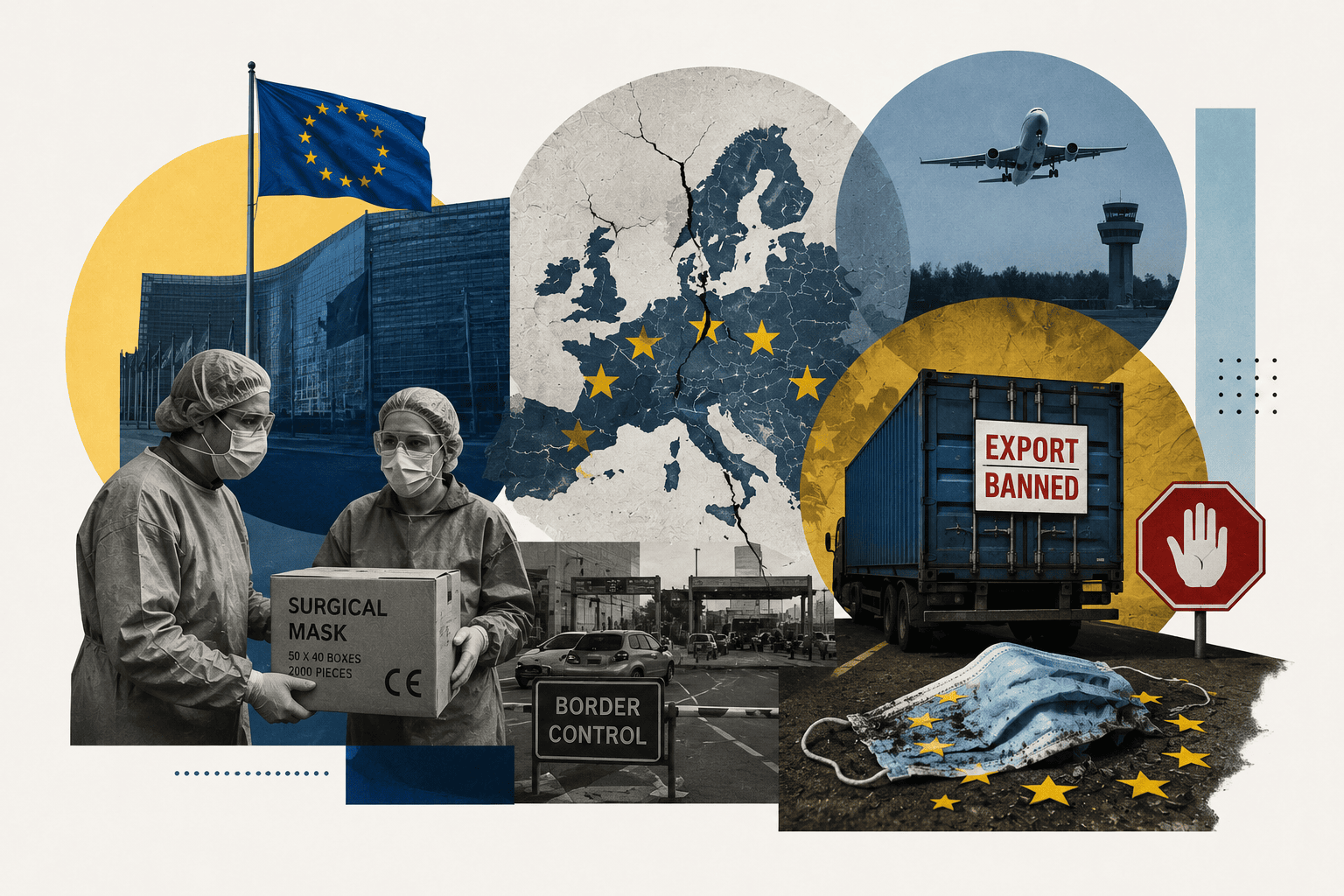

The European Union has long been presented as a political project built upon shared values, solidarity, and the ability to act collectively. Yet the succession of crises in recent years has revealed just how fragile this image of unity has become. Today, Europe’s greatest challenge is not simply migration, war, or economic stagnation. Rather, it is its growing inability to respond to these crises with a common political will. With every new challenge, different capitals speak with different voices, gradually eroding the European Union’s capacity to formulate coherent common policies.
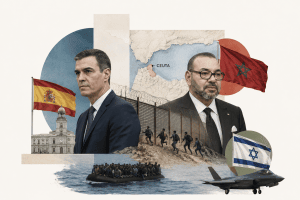
The migration crisis in Ceuta is the latest and perhaps one of the clearest illustrations of this trend. After tens of thousands of migrants crossed from Morocco into the Spanish enclave of Ceuta in North Africa, one might have expected a unified European response. Instead, Italy announced the temporary suspension of the Schengen free movement regime with Spain. Yet Ceuta itself already falls outside the normal Schengen free movement framework. While Madrid insisted that it had largely brought the crisis under control, Rome’s decision was widely interpreted as a message aimed primarily at domestic politics. Spain, in turn, accused Italy of acting out of ignorance, political opportunism, and bad faith. Rather than producing a common solution, EU member states once again turned against one another, exposing one of the Union’s deepest vulnerabilities.
Solidarity That Disappears in Times of Crisis
This pattern is far from new. The COVID-19 pandemic had already exposed the fragility of European solidarity from its very first days. As hospitals across the continent became overwhelmed and healthcare workers struggled to obtain protective equipment, member states focused on securing medical supplies for themselves rather than helping one another. Germany and France imposed restrictions on exports of masks and protective equipment. Accusations emerged that shipments destined for Italy and Spain had been blocked or confiscated. European countries effectively accused one another of “stealing masks.” The principles of the single market quickly gave way to border restrictions and national stockpiling. Italy, the country hit hardest during the early stages of the pandemic, openly pointed out that its first substantial assistance came not from its European partners but from countries outside the Union, including China and Russia.
Russia’s invasion of Ukraine further tested the European Union’s claims of unity. Poland and the Baltic states advocated the toughest sanctions against Moscow and called for stronger military support for Kyiv, while Hungary pursued a markedly different course, repeatedly threatening to veto key European decisions. Similar divisions emerged over energy policy. While some countries pushed for a rapid disengagement from Russian gas, others adopted a far more cautious approach because of the economic costs involved.
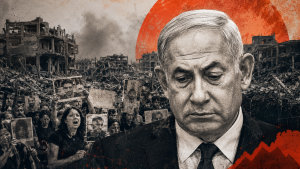
The war in Gaza has further highlighted the EU’s inability to formulate a common foreign policy. Spain, Ireland and several other member states have called for stronger support for the Palestinian cause, whereas Germany and several Central European countries have maintained a more pro-Israeli position. For weeks, the European Union struggled to speak with one voice. Statements issued from Brussels often contrasted sharply with those made by national leaders, once again exposing the limits of European foreign policy coordination.
Common Institutions, Diverging Political Interests
Migration policy has long remained one of Europe’s deepest fault lines. Italy and Greece argue that they are carrying a disproportionate share of the burden at the Union’s external borders, while several Central European countries continue to reject mandatory migrant relocation schemes. Even France and Germany regularly diverge over migration priorities. Border states call for greater solidarity, whereas others focus primarily on preventing migration from reaching their own territories. The result is not a genuinely common migration strategy but a fragmented policy shaped by domestic political calculations and national concerns.
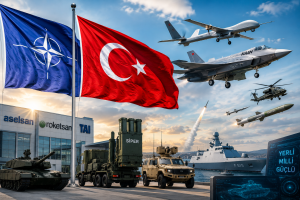
The same fragmentation is evident in the field of defence. France continues to champion the idea of European strategic autonomy, whereas many other member states define their security primarily through NATO and the United States. Although discussions about a European army have persisted for years, little concrete progress has been achieved, illustrating the absence of a shared strategic vision.
One of the clearest examples is the Future Combat Air System (FCAS), jointly developed by France, Germany and Spain. Conceived as Europe’s flagship next-generation defence programme, the multi-billion-euro project has repeatedly been delayed due to disagreements over technology sharing, intellectual property rights, industrial workshare and leadership. Even Europe’s most ambitious defence initiative has struggled to overcome national interests and industrial rivalries, raising serious questions about the Union’s capacity to develop a truly common defence policy.
Economic crises have revealed similar divisions. During the Eurozone debt crisis, northern member states demanded fiscal discipline while southern countries called for greater solidarity and common borrowing mechanisms. Even the establishment of the post-pandemic recovery fund required lengthy and difficult negotiations. As energy prices surged, every government prioritised protecting its own industries and consumers. Germany’s extensive state aid packages, made possible by its stronger fiscal position, generated concerns among less affluent member states about unfair competition within the single market.
Europe also remains divided in its approach to China. While some governments increasingly view Beijing primarily as a strategic and security challenge, others seek to preserve economic ties and Chinese investment. Differences are equally apparent in relations with the United States. Some member states favour maintaining the closest possible alignment with Washington, whereas France and several others continue to argue that Europe should become a more autonomous geopolitical actor.
None of this necessarily means that the European Union is on the verge of collapse. However, Europe is no longer capable of acting collectively as instinctively as it once claimed. In times of stability, the Union appears strong thanks to its institutions, common market and shared legal framework. Yet whenever a major crisis emerges, national interests rapidly take precedence over the idea of a common European identity. National capitals expect solutions from Brussels, while Brussels itself can only act once those same capitals reach consensus.
Perhaps the European Union’s greatest test is not the scale of the crises it faces, but whether it is capable of behaving as a genuine union when confronted with them. A common market, a shared currency, open borders and common institutions are not sufficient by themselves to create political unity. If member states respond to pressure on one country’s borders by closing their own, if every capital adopts a different position when war breaks out, and if governments accuse one another of confiscating medical supplies during a pandemic, then institutional integration alone cannot sustain a genuine sense of shared destiny.
The Ceuta crisis is therefore far more than a temporary dispute between Spain and Italy over Schengen. It is the latest manifestation of a deeper contradiction that resurfaces with every major crisis: Europe aspires to act as a union, yet repeatedly reverts to national reflexes whenever the political cost of solidarity becomes too high. The European Union may continue to endure as a legal and institutional entity, but as the principle of solidarity continues to erode, it risks becoming an increasingly fragile, less effective and less influential actor on the global stage.