
Recent developments in the Middle East suggest that Türkiye is becoming an increasingly important actor not only in Syria and Gaza, but also in shaping Lebanon’s future.
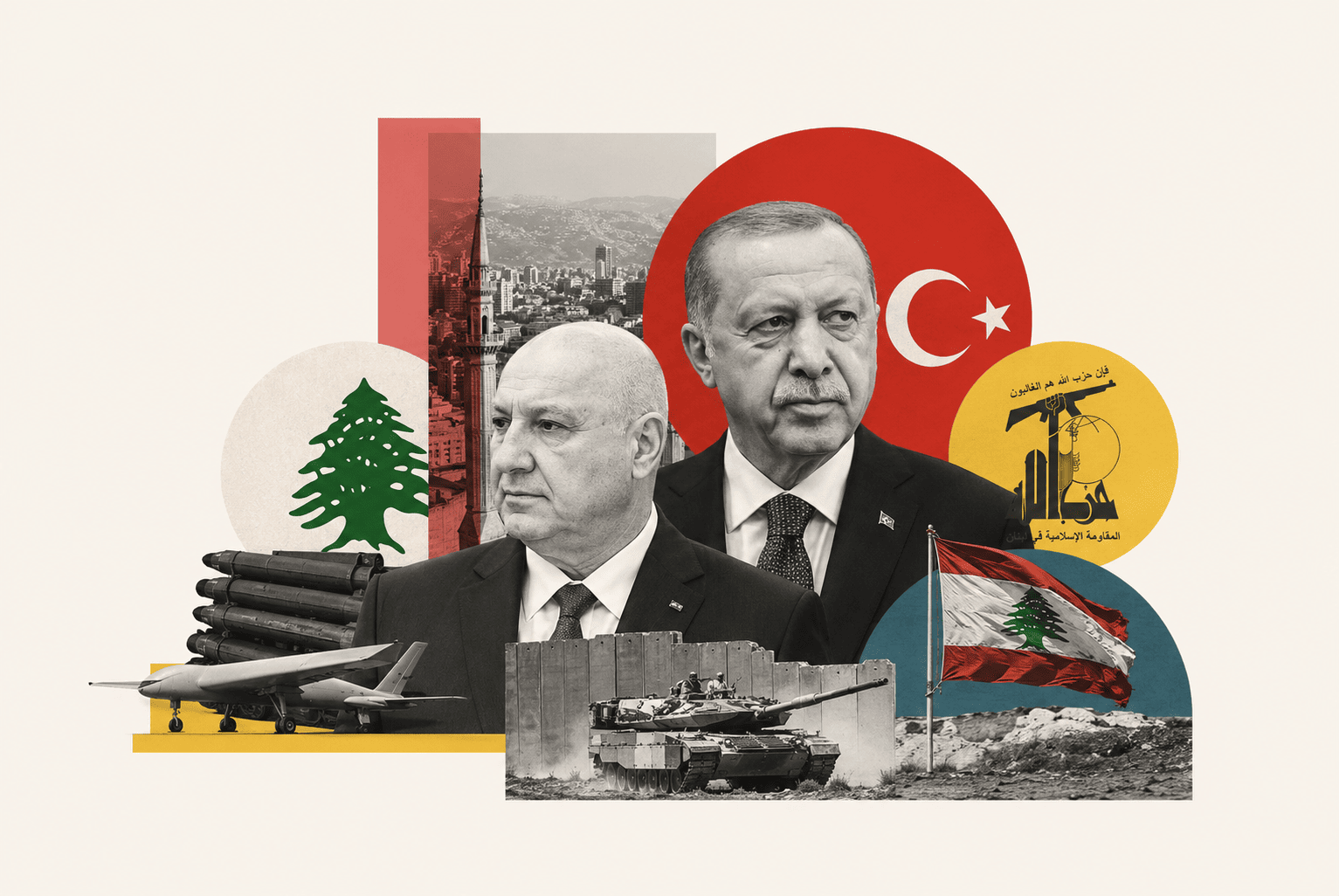
According to an article published on 8 August by the leading Lebanese newspaper An-Nahar, Ankara has become involved in one of the region’s most complex and sensitive issues: the disarmament of Hezbollah. The newspaper claims that during President Recep Tayyip Erdoğan’s meeting with Lebanese President Joseph Aoun in Ankara, a striking proposal was discussed under which Hezbollah’s heavy weapons would be transferred to Iran under Turkish and Iranian supervision.
Hezbollah’s arsenal has long been one of the most contentious issues in Lebanese politics. President Aoun has argued that restoring the state’s sovereignty across the country ultimately requires weapons to be brought under state control. Shortly before his visit to Ankara, he also stressed the need to strengthen the Lebanese Armed Forces, describing Türkiye as an important actor capable of mobilising international support for a new security mechanism, given its NATO membership and extensive regional ties. Aoun has also maintained that the question of Hezbollah’s weapons should be resolved not through confrontation, but through a gradual process based on domestic dialogue.
The formula reported by An-Nahar takes this debate in a different direction. Alongside the option of transferring Hezbollah’s heavy weapons — including missiles and unmanned aerial vehicles — to the Lebanese Armed Forces, another proposal reportedly envisages moving them to Iran under the supervision of Ankara and Tehran. In return, Israel would fully withdraw from southern Lebanon, while the United States and other relevant actors would provide guarantees against renewed Israeli military action. Hezbollah’s light and medium weapons could then be addressed at a later stage through negotiations with the Lebanese government. Hezbollah, however, has yet to respond to the proposal.
The most significant aspect of this plan is that it seeks to incorporate Hezbollah into a broader regional settlement rather than attempting to dismantle the organisation through force. Such a mechanism could place Türkiye at the centre of an exceptionally delicate equation involving the United States, Iran, Israel and Lebanon. Ankara’s ability to maintain channels of communication with Tehran, engage directly with Washington, cultivate close relations with the Lebanese leadership and, at the same time, openly oppose Israel’s military expansion in the region gives Türkiye a degree of diplomatic manoeuvrability that few other actors possess.
Ankara’s approach towards Hezbollah is equally important. According to An-Nahar, Türkiye never viewed Hezbollah’s intervention in the Syrian war on behalf of Bashar al-Assad’s government favourably and remains politically distant from the organisation. At the same time, Ankara does not want to see Hezbollah comprehensively defeated by Israel. Türkiye may therefore be seeking a formula that links restrictions on Hezbollah’s military capabilities to an end to Israeli military pressure on Lebanon, treating the two issues as interconnected components of the same settlement.
Türkiye Could Deploy Troops to Lebanon
The second dimension of the proposed arrangement concerns the future of southern Lebanon.
An-Nahar reports that, should an agreement be reached, the deployment of a new international force along the Lebanese-Israeli border could be considered, with Türkiye potentially contributing troops. Ankara, however, appears to have drawn an important red line. A Turkish official cited by the newspaper reportedly stated that Türkiye would not deploy forces without the necessary understanding with Washington and would not accept a scenario in which Turkish troops could come under Israeli fire.
For now, all of this remains a scenario under discussion in diplomatic circles, and there is no guarantee that Hezbollah will accept such an arrangement. Yet the very fact that such a proposal is reportedly being discussed illustrates how Türkiye’s position within the Lebanese equation may be changing. Until relatively recently, Ankara was a more limited actor in Lebanon. Today, its name is increasingly associated with a much broader set of issues, ranging from strengthening the Lebanese Armed Forces and securing southern Lebanon to Hezbollah’s disarmament and an Israeli withdrawal.
If the formula reported by An-Nahar can be translated into an actual agreement, its implications would extend far beyond the question of Hezbollah’s weapons. Türkiye could emerge as a mediator in efforts to manage the confrontation between Israel and one of Iran’s most important regional allies, while simultaneously assuming a direct role in shaping Lebanon’s emerging security architecture.
The larger question, therefore, may not simply be whether Hezbollah will be disarmed under Türkiye’s supervision. It is whether, after Syria, Türkiye is now becoming one of the principal regional actors shaping Lebanon’s future.