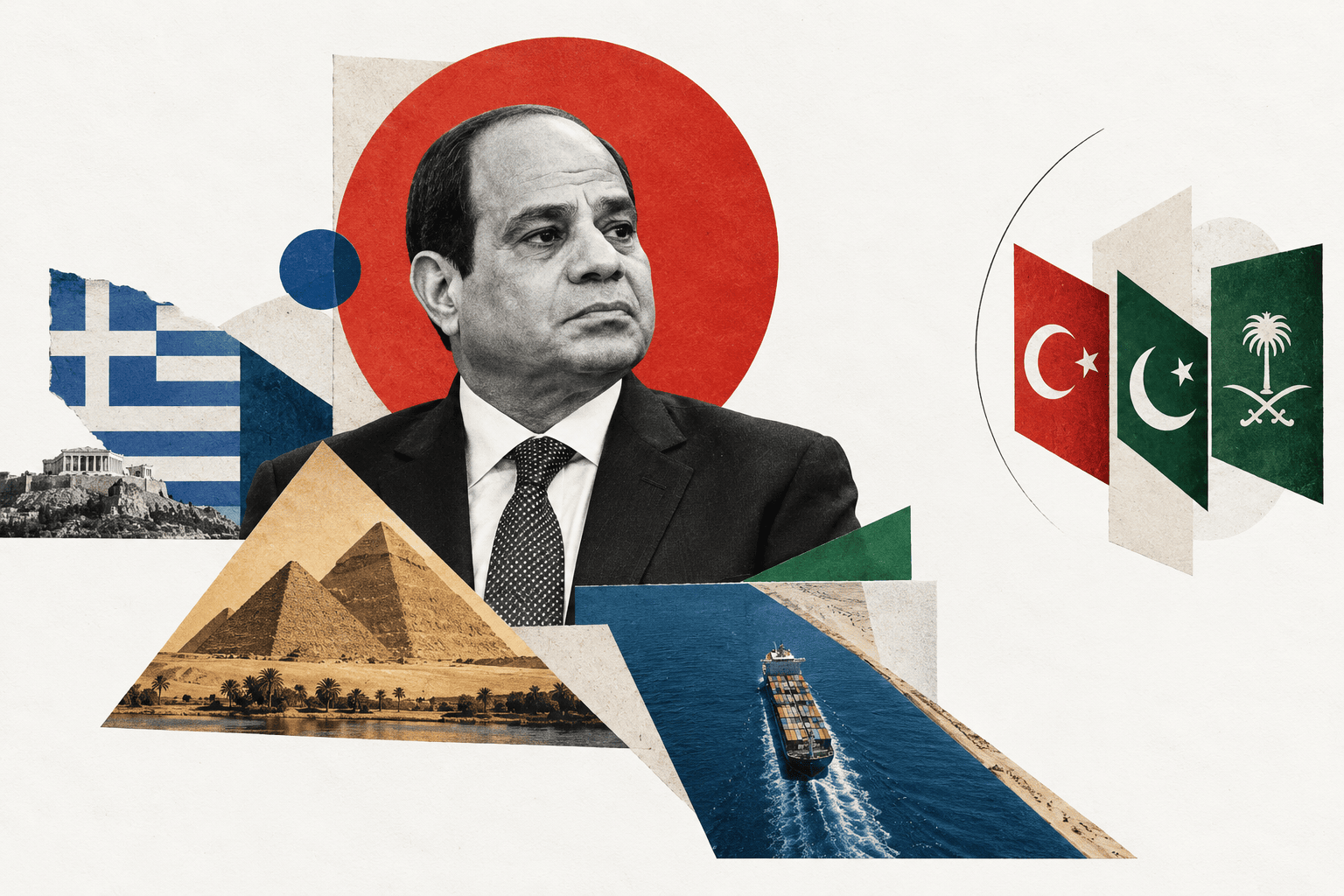
As a new defence partnership emerges in the Middle East, the absence of the Arab world’s most populous country is striking. With its large military, control of the Suez Canal and strategic position spanning the Mediterranean and the Red Sea, Egypt might seem a natural partner for such an alliance. Yet Cairo’s reluctance has less to do with its military capabilities than with its political and economic dependencies.
Samuel Forey’s reporting in Le Monde sheds light on this tension. Egypt’s relationships with its various partners do not always reinforce one another. When their interests clash, Cairo’s room for manoeuvre narrows. Nor is the question simply whether Sisi wants to join the alliance: it also matters whether its existing members see Egypt as a reliable partner.
Sisi Wants His Partners’ Support Without Taking On Their Conflicts
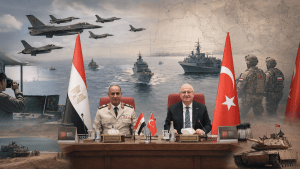
The course of relations between Türkiye and Egypt offers a revealing example. Ties ruptured after Sisi came to power in the 2013 military coup, then deteriorated further over disagreements in Libya and the Eastern Mediterranean. Egypt’s 2020 maritime delimitation agreement with Greece deepened the rift between Ankara and Cairo.
The normalisation process that began in 2021 gathered pace with the restoration of ambassadors in 2023 and reciprocal presidential visits in 2024. But diplomatic rapprochement did not mean a wholesale shift in Egypt’s regional priorities. Even as Cairo rebuilt relations with Türkiye, it maintained its energy and security cooperation with Greece and Cyprus.
Maintaining several partnerships is not inherently contradictory. But ties with countries at odds with one another take on a different significance when mutual defence obligations enter the picture. Economic and diplomatic cooperation with Ankara can advance on the basis of shared interests. Joining the same security framework requires much closer agreement on what constitutes a threat and how to respond when a crisis erupts.
Egypt’s Gulf relationships present a similar dilemma. Saudi support matters to Cairo, but the United Arab Emirates is also one of the Sisi government’s main financial backers. When Riyadh and Abu Dhabi pursue different regional priorities, keeping both satisfied becomes harder. In theatres of competition such as Sudan, joining a defence alliance could make Cairo’s carefully maintained ambiguity untenable.
Claims originally published by Middle East Eye and cited by Le Monde point to another side of the story: Riyadh reportedly has reservations about both Egypt’s potential military contribution and Sisi’s loyalty. If accurate, these claims suggest that Egypt’s absence cannot be explained solely as a decision of its own making.
Relations with the United States and China raise much the same question. Cairo wants to preserve its military ties with Washington while expanding economic and technological cooperation with Beijing. As competition between the major powers intensifies, however, that balancing act becomes more costly. Sisi’s pursuit of a diversified foreign policy gives Egypt options, but also leaves it exposed to pressure from several directions.
Keeping the Mecca Alliance at arm’s length therefore amounts to more than diplomatic caution. It also reveals the limits of a government that depends on financial support from multiple capitals when faced with binding security commitments. Sisi appears intent on maintaining as many partnerships as possible while avoiding direct involvement in any one partner’s conflicts.
Yet the Houthi attacks could put that calculation under new strain. As threats to Saudi security test solidarity within the Mecca Alliance, instability in the Red Sea also directly affects Egypt’s interests through the Suez Canal. The response from Ankara and Islamabad will matter, but so will the responsibilities Sisi is prepared to assume. Will Cairo offer Riyadh political support alone, limit its contribution to maritime security, or take more substantial action? The Mecca Alliance’s first serious test could also reveal how much confidence Sisi can inspire in his partners.