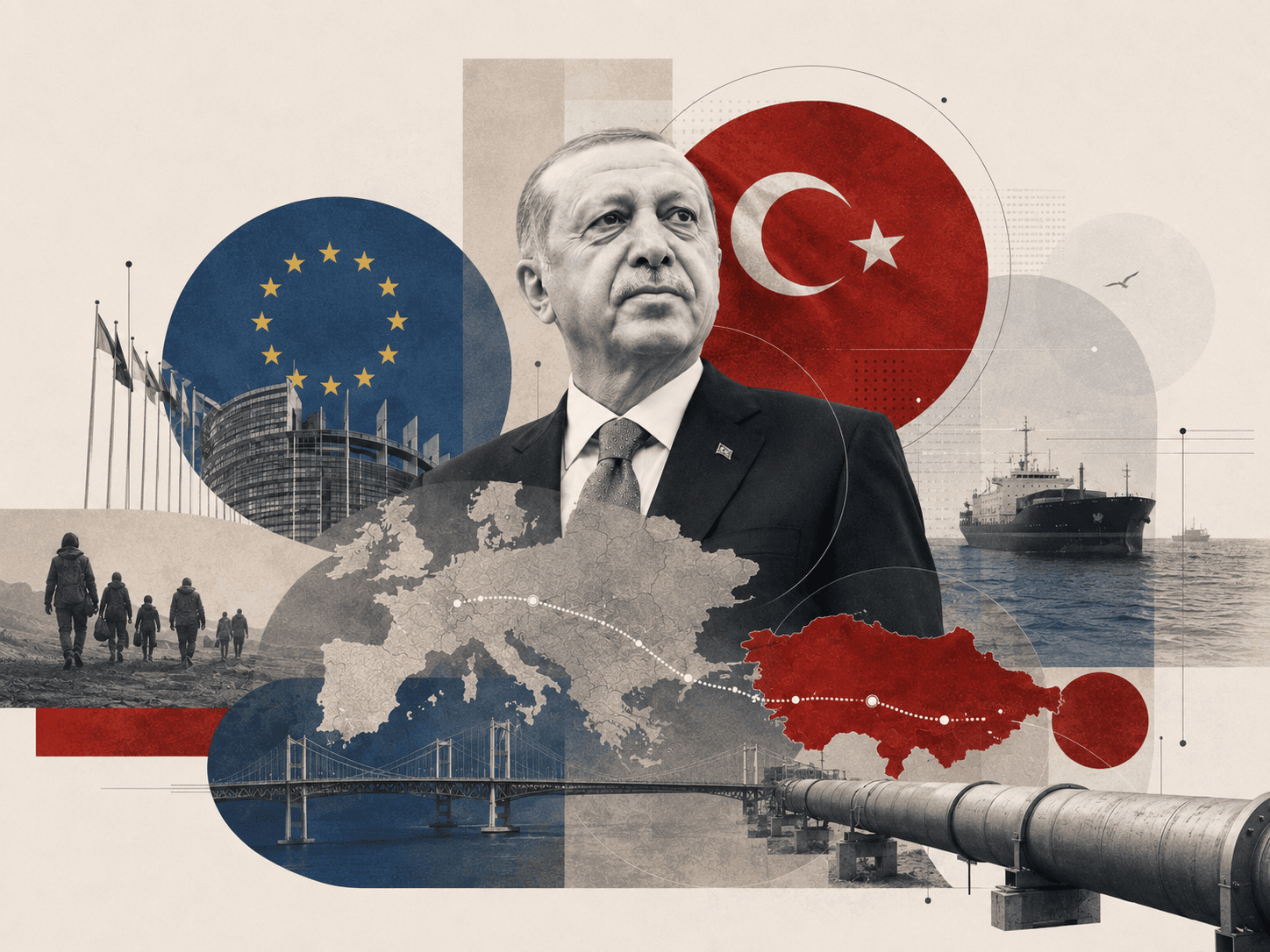

President Recep Tayyip Erdoğan’s statement in an interview with Al Jazeera that “the European Union is not our priority” is one of the clearest expressions yet of both the frustration that has accumulated over decades in Türkiye–EU relations and the shifting balance of power between the two sides. At the same time, Erdoğan stressed that Türkiye had not abandoned the prospect of EU membership altogether: “We have not closed the door. We still envisage joining the European Union.”
This rhetoric marks a notable departure from Erdoğan’s earlier assertion that “full membership of the European Union is our strategic objective”. Precisely for that reason, his latest remarks are significant: they point to a broader change in Ankara’s perception of Europe and of Türkiye’s place within the European order.
Yet the message is not one of disengagement from Europe. Rather, Ankara is signalling that it no longer intends to make Türkiye’s future contingent on a decision over membership taken in Brussels. Behind this shift lies a combination of factors: a membership process stretching back more than six decades, a growing perception in Türkiye that the EU has applied double standards, and a rapidly changing geopolitical environment that has altered the strategic calculus on both sides.
From Six Decades of Waiting to a Shifting Balance of Power
Türkiye’s integration with Europe has a long history. Ankara applied to the European Economic Community in 1959; the Ankara Agreement was signed in 1963; Türkiye submitted its application for full membership in 1987; the Customs Union was established in 1995; Türkiye was formally recognised as a candidate country in 1999; and accession negotiations began in 2005. Yet despite this long trajectory, the prospect of membership has become progressively more remote and uncertain.
Erdoğan’s declaration that the EU is no longer a priority therefore cannot be understood merely as a response to the politics of the moment. It rests on a process that has spanned generations and repeatedly failed to deliver its promised outcome. Türkiye has developed deep economic and institutional integration with Europe, yet the persistent deferral of political membership has strengthened the view in Ankara that the EU has treated Türkiye differently from other candidate countries.
Cyprus remains one of the most consequential examples of this perception. In 2004, the UN-backed Annan Plan was approved by Turkish Cypriots but rejected by Greek Cypriots. Nevertheless, the Republic of Cyprus joined the European Union shortly afterwards. In subsequent years, the Cyprus dispute became a political obstacle to the opening and closing of several chapters in Türkiye’s accession negotiations. From Ankara’s perspective, this reinforced the belief that the EU had, in effect, allowed one of its own political choices to undermine the very settlement framework it had previously supported.
A similar sense of disappointment followed the 2016 Türkiye–EU migration agreement. Visa liberalisation and the modernisation of the Customs Union were placed on the agenda, yet years later neither has produced the progress Ankara expected.
It is against this background that Erdoğan’s remark, “If they take us, fine; if they do not, fine”, acquires its broader meaning. Ankara is moving away from an approach that placed EU accession at the centre of Türkiye’s foreign-policy horizon. It still seeks strong political and economic relations with Europe and has not formally closed the door on membership. What it increasingly rejects, however, is the notion that Türkiye’s international standing should ultimately be determined by a decision taken in Brussels.
The wider international environment has also transformed the balance of strategic dependence.
Europe is facing one of the most serious challenges to its post-Second World War security order. The war in Ukraine has elevated the strategic importance of the Black Sea, while questions surrounding European defence capabilities, NATO’s future and the durability of the US security commitment to Europe have become increasingly pressing. In this environment, Türkiye’s position is difficult to overlook. It possesses one of NATO’s largest armed forces, controls access to the Black Sea through the Turkish Straits and sits at the intersection of Europe, Russia, the Caucasus and the Middle East.
Migration adds another layer to this strategic equation. Situated along one of the principal routes connecting the Middle East to Europe, Türkiye remains exceptionally important to European border and migration management. Energy security presents a similar picture: Türkiye is a key transit corridor for resources from the Caspian basin, Central Asia and the Middle East to reach European markets. Ankara’s expanding diplomatic reach across Africa, the Gulf, Central Asia and the wider Middle East further increases its relevance as an actor operating across Europe’s immediate neighbourhood.
Türkiye’s transformation in defence and security is also changing the relationship. The country is no longer merely a beneficiary of NATO’s security architecture. It has developed a substantial indigenous defence-industrial base, ranging from unmanned aerial systems and naval platforms to missiles and electronic warfare technologies, and has increasingly become a supplier to European countries themselves. At a time when Europe is rearming and seeking to strengthen its defence-industrial capacity, Türkiye’s military and industrial capabilities carry considerably greater weight than they did a decade ago.
Erdoğan’s remarks therefore speak not only to a shift in Türkiye’s attitude towards the EU, but also to a broader transformation in the relationship between the two sides. For decades, the dominant question was: “When will Türkiye join the European Union?” Today, a different question is becoming increasingly relevant: how effectively can Europe manage its security, migration policy, Black Sea strategy, energy corridors and crises in its wider neighbourhood without Türkiye?
The EU remains a crucial economic and political partner for Türkiye. In 2025, 42.7 per cent of Türkiye’s goods exports went to EU member states, while bilateral trade in goods exceeded €217.6 billion. The economic relationship is therefore deep and cannot easily be disentangled. But Ankara now has a far broader field of manoeuvre, stretching from the Gulf and Central Asia to Africa and the wider Asian continent.
Europe, by contrast, cannot alter its geography. It cannot relocate the Black Sea, move the Middle East further away or create an alternative geopolitical bridge in place of Türkiye.
This is the strategic logic underpinning Erdoğan’s warning that “you will be the ones who lose, not Türkiye”. Türkiye’s need for Europe has not disappeared. But Europe’s dependence on Türkiye across security, migration, energy and defence has become far more visible than it was in the past.
Perhaps the most significant change in Türkiye–EU relations is therefore not taking place at the negotiating table, but in the psychology of power. For years, Türkiye was portrayed as the party waiting at Europe’s door. In today’s altered geopolitical environment, Ankara is seeking to reverse that perception.
Its message is increasingly clear: Türkiye may still need Europe, but Europe now needs Türkiye more.