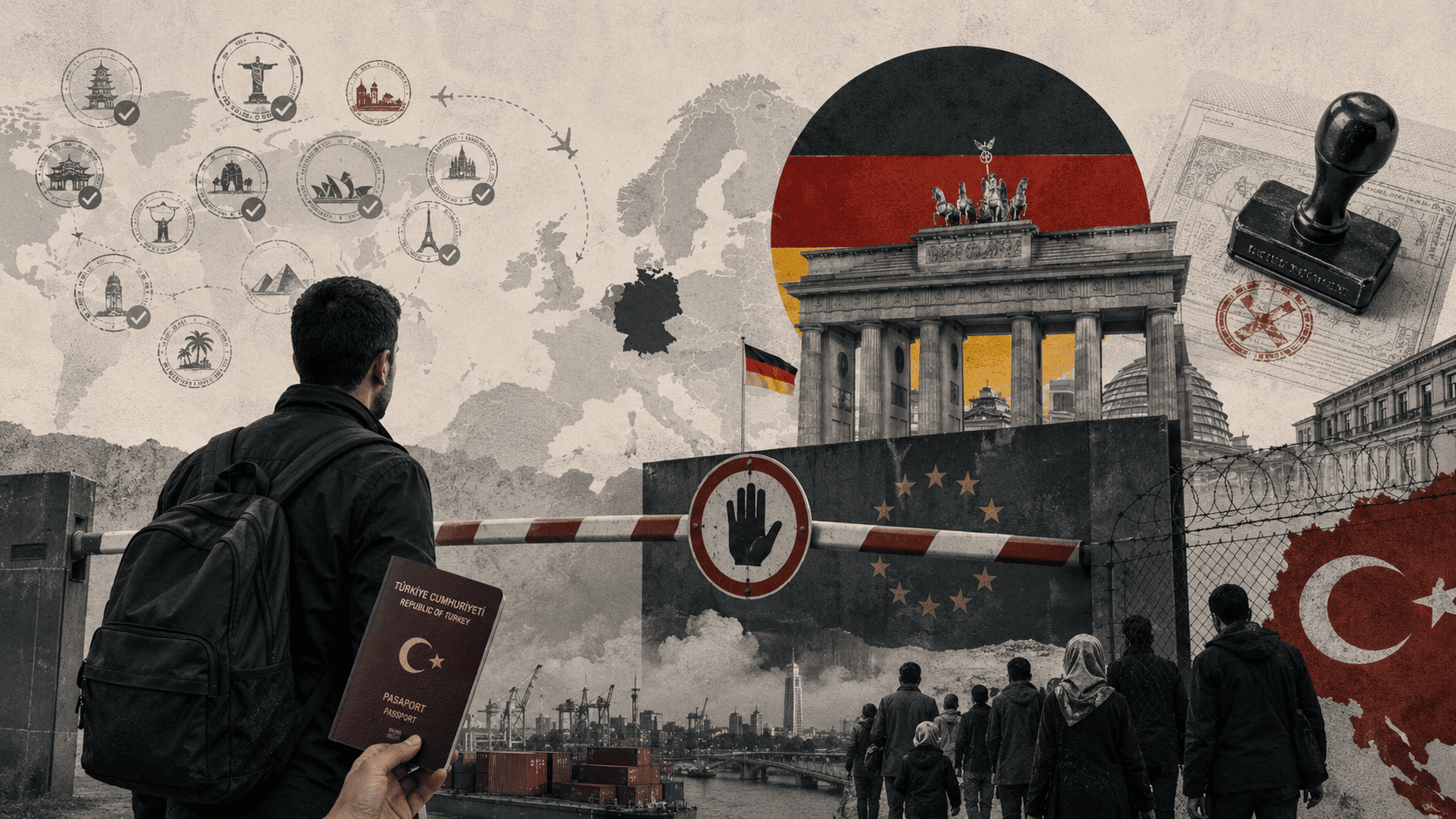

Under the Schengen visa regime, citizens of 62 countries outside the European Union can travel to Germany without a visa for up to 90 days within any 180-day period. The list includes countries such as Kiribati, Tuvalu, Palau, Timor-Leste, Nicaragua and Venezuela, despite their relatively limited economic and social ties with Germany. Türkiye, however, has once again been left out.
Since the signing of the Labour Recruitment Agreement in 1961, millions of Turks have migrated to and settled in Germany. Today, Germany is home to a large Turkish community while also remaining one of Türkiye’s most important trading partners. Against this backdrop, Germany’s continued enforcement of strict visa rules for Turkish citizens represents a political contradiction that can no longer be explained solely through technical criteria.
Türkiye has not been waiting at Europe’s door for a few years, but for more than half a century. Its relations with the European Economic Community were institutionalised through the Ankara Agreement signed in 1963. Türkiye applied for full membership in 1987, was granted candidate status in 1999 and began accession negotiations in 2005. Despite this, the accession process has effectively stalled, visa liberalisation has never been completed and access to Europe has become increasingly difficult for Turkish citizens.
Today, an ordinary Turkish citizen wishing to travel to Germany for a short family visit, a business meeting, a trade fair or a holiday may have to wait weeks just to secure an appointment. Applicants must submit extensive documentation, ranging from bank statements and employment records to property deeds and invitation letters, while also proving that they will return to Türkiye at the end of their trip.
When an application is rejected, applicants often struggle to obtain a clear and satisfactory explanation. Meanwhile, citizens of dozens of countries that do not have ties with Germany as strong as Türkiye’s can enter the country with nothing more than their passports.
Yet the relationship between Germany and Türkiye goes far beyond an ordinary foreign policy partnership. Germany is one of Türkiye’s largest export markets and most important trading partners. Thousands of German companies operate in Türkiye, while the two countries’ industrial and supply chains are closely interconnected. Germany’s Turkish community, numbering in the millions, also forms a unique human bridge between the two societies. When trade, investment and social ties are this extensive, it is unacceptable for Turkish citizens to continue being treated as potential migrants.
Germany’s strict visa regime for Turkish citizens is increasingly turning into a politically motivated instrument of pressure. Berlin regards Türkiye as a strategic partner in a wide range of areas, from security and the economy to migration management and defence. Yet when the freedom of movement of Turkish citizens is concerned, that understanding of partnership disappears. Türkiye is expected to share Europe’s burdens in migration, security and defence, while Turkish society is denied equal and dignified travel opportunities.
The cost of this double standard is not borne solely by those waiting in visa queues. People who feel close to Europe and seek to build ties with Germany through education, trade and culture are also pushed a little further away from Europe with every rejected application.
If Germany genuinely wants to build a lasting relationship with Türkiye based on trust, it must first stop leaving Turkish citizens waiting at the door. A strategic partnership cannot be built on borders that are open to goods and capital but closed to people.