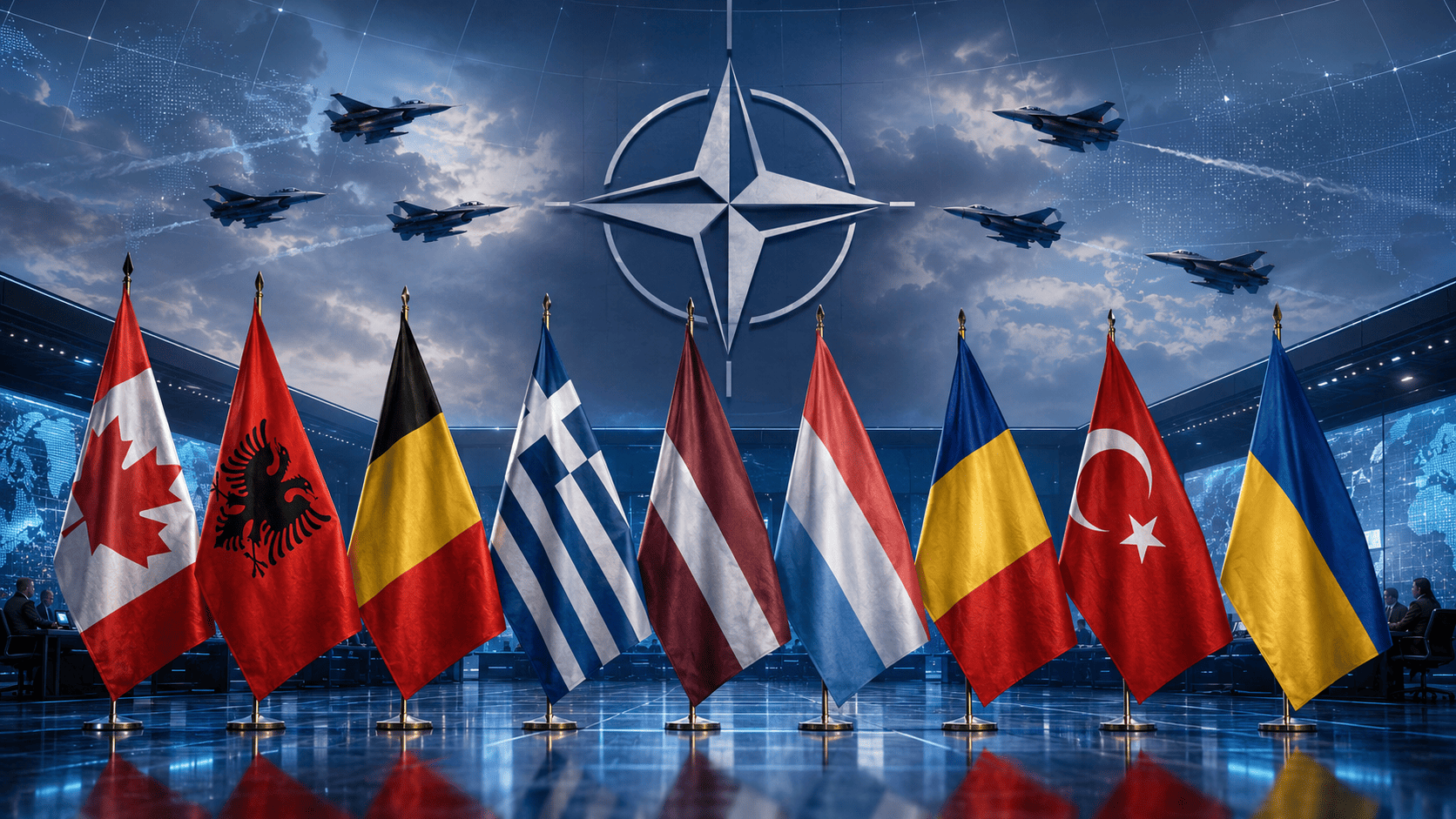
During the NATO Summit held in Ankara, Canadian Prime Minister Mark Carney announced that nine countries supported the creation of the Defense, Security and Resilience Bank. In addition to Canada, the list included Türkiye, Albania, Belgium, Greece, Latvia, Luxembourg, Romania and Ukraine. The joint declaration also formally recorded these countries’ intention to establish a new multilateral financial institution.
Despite this, Ankara sent more cautious signals immediately after the summit. Turkish defense sources indicated that Türkiye had not yet made a final commitment to joining the bank and that the relevant institutions were still evaluating the matter. A few days later, however, a Turkish official said that Ankara had formally conveyed its decision to become a founding member to the Canadian authorities.
At first glance, this brief hesitation may look like a policy reversal. But the issue was never simply a matter of choosing whether to “join” or “not join.” A more fundamental question stood before Ankara: should Türkiye remain outside the West’s emerging defense-financing architecture, or should it take its place at the table while the rules are still being written?
The New Defense Bank Aims to Turn the West’s Rearmament Decision into Industrial Capacity
The Defense, Security and Resilience Bank is not being designed as an ordinary financial institution that collects deposits like a commercial bank. Instead, the goal is to create a multilateral structure resembling the World Bank or regional development banks, but focused specifically on defense and security investments.
The bank’s main purpose is to ensure that allied countries can access longer-term and lower-cost financing for their defense projects. According to the Canadian government, the institution will use public guarantees to mobilize private capital in order to increase defense production, strengthen supply chains, and support small and medium-sized companies in particular, especially those that struggle to obtain financing.
Under the proposed model, the capital contributions and guarantees provided by member states will enable the bank to borrow on international markets at lower cost. It will then be able to provide favorable credit to governments, defense companies and joint projects. Its targeted financing capacity could reach £100 billion, or roughly $134 billion. This figure does not refer to money that member states would inject directly into the bank, but rather to the total financial capacity the institution aims to generate on the back of a strong credit rating.
The bank’s emergence is directly linked to NATO countries’ decision to increase defense spending. In recent years, politically approved increases in defense budgets have not translated into productive capacity at the same pace. Expanding ammunition plants, increasing air-defense systems, building new shipyards and scaling up smaller suppliers all require very large amounts of capital.
Traditional banks, however, have often been reluctant to lend to the defense sector because of the political, ethical and reputational risks involved. The new institution is intended precisely to fill that gap. It will not simply make it easier for states to purchase weapons; it will also seek to finance a broad production chain extending from fighter aircraft and unmanned aerial vehicles to missile systems and cybersecurity infrastructure.
That is why it would be too narrow to view this initiative simply as “a new bank for NATO countries.” It is shaping up to become one of the instruments that could translate the West’s decision to rearm into real economic and industrial capacity.
Moreover, although it is sometimes described as a “NATO bank,” the structure will not be directly tied to NATO itself. It is being conceived as a separate international financial institution, established under Canadian leadership among countries that share similar security concerns. This distinction matters especially for Türkiye. Because Ankara is not a member of the European Union, it has only limited access to certain European defense mechanisms, whereas this new structure gives it the opportunity to become a founding partner.
Türkiye Wants to Help Shape Defense Financing Before Others Write the Rules Without It
There may be several reasons why Türkiye initially acted with caution. Since none of them has been officially explained, it is impossible to speak definitively of a specific bargain or concession. Even so, the institutional and strategic logic behind the decision points to several strong possibilities.
The first issue may have been financial obligations. Founding membership will not be limited to a simple political endorsement. Member states’ capital contributions, the guarantees they provide, the risks they assume and the voting rights they receive will all have to be defined. Institutions such as the Ministry of Treasury and Finance, the Ministry of National Defense, the Ministry of Foreign Affairs, and the Presidency of Defense Industries would therefore have needed to assess these details carefully. Ankara’s brief hesitation can thus be read less as a genuine refusal than as a desire to see the final terms before committing.
The second issue may have concerned the extent to which Turkish defense companies would be able to benefit from the opportunities created by the bank. For Türkiye, membership would only make sense if financing were genuinely available to Turkish producers, joint projects and supply chains based in Türkiye. Ankara would hardly be expected to accept a structure to which it contributes capital and guarantees while its own companies are excluded on political grounds.
But the more decisive reason pushing Türkiye toward founding membership may well have been the cost of staying outside.
In any new international institution, the most critical phase is the founding stage. That is when governance arrangements, voting shares, credit conditions, priority sectors and the companies eligible for support are determined. Had Türkiye joined at a later stage, it might have found itself obliged to comply with rules written by others. Founding membership, by contrast, gives Ankara the opportunity to shape the system from within.
At this point, the fact that Greece is also among the first members is striking. A defense-financing mechanism in which Athens had a place from the outset while Ankara remained outside could have created both economic and political problems for Türkiye. There is no official statement indicating that Greece’s participation directly changed Türkiye’s decision. Still, it is a strong possibility that Ankara did not want to leave its regional rival room to help shape the first rules of a new institution on its own.
Another dimension of the decision concerns access to the European defense market. Because Türkiye is not a member of the European Union, it is not accepted as a full partner in some of the defense funds created by Brussels. While European countries are showing growing interest in Turkish ammunition, drones, armored vehicles and electronic systems, they have also tried to keep Ankara outside the decision-making mechanisms.
The Canada-backed bank could provide a channel for partly overcoming that contradiction. Since it is not tied to the EU, the institution allows Türkiye to enter the West’s defense-financing system independently of the political debates surrounding EU membership. This gives Ankara the chance to approach the economic opportunities generated by Europe’s security needs not only as an exporter, but as a founding partner.
For Türkiye’s defense industry, the main bottleneck is no longer so much product development as the ability to reach the production capacity needed to fulfill large orders on time. Around the major companies, hundreds of smaller suppliers need new machinery, new facilities and working capital. If the bank functions as intended, it could open up new financing possibilities for these firms.
This is where the central argument behind Ankara’s choice becomes clear: Türkiye is not merely looking for a new source of credit. It wants to sit at the table where decisions are made about which countries, which projects and which companies will receive capital in the new era of Western rearmament.
For that reason, this change in position can be seen less as a retreat than as a strategic adjustment. Ankara first weighed the financial and legal conditions of membership, then concluded that remaining outside would be riskier than being inside.
Türkiye’s founding membership does not, by itself, guarantee the bank’s success. The fact that no major G7 economies other than Canada are involved at the initial stage raises questions about the institution’s capital strength. The fact that the United Kingdom, the Netherlands, Finland and Poland are working on a separate defense-financing mechanism also shows that the West has not yet converged around a single and unified model.
The real questions start now. How much capital will Türkiye contribute? How much voting power will it obtain? Will Turkish companies have fair access to the bank’s credit? Will joint financing translate into joint production and export projects?
The answers to these questions will determine whether this membership remains a largely symbolic diplomatic success or becomes a concrete lever that accelerates the growth of Türkiye’s defense industry.
Yet this initiative already points to a broader transformation: in tomorrow’s military competition, power will belong not only to the countries that produce the most advanced weapons, but also to those that can finance their production. After making major advances in defense technology in recent years, Türkiye is now seeking to convert that progress into financial and institutional influence.