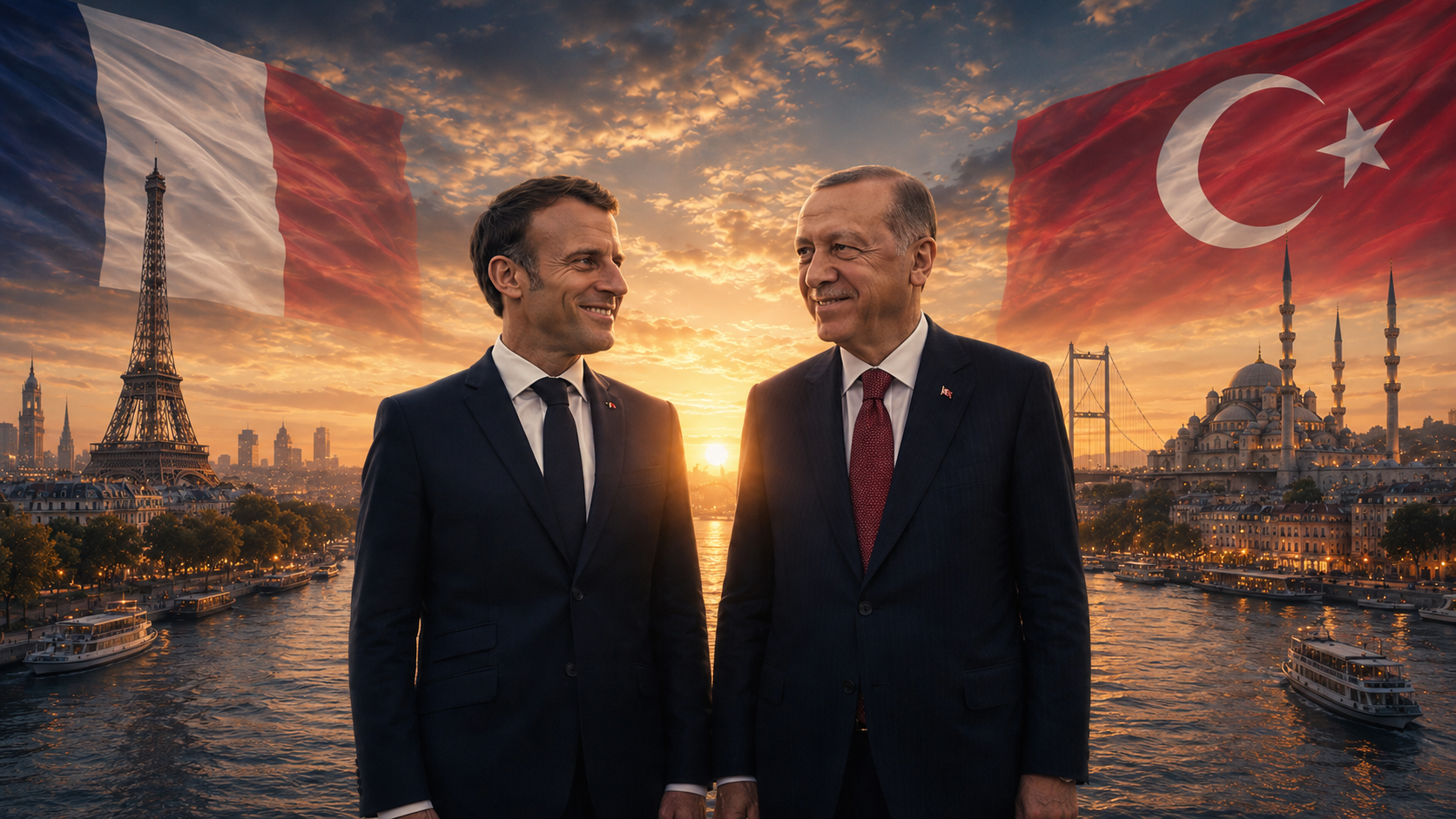
While everyone continues to discuss Macron’s morning run through Ankara during the NATO Summit and his black sunglasses, a much more important question deserves attention: are the tensions between these two rival countries beginning to ease?
There are strong reasons to ask this question. Macron and President Recep Tayyip Erdoğan held a meeting lasting nearly an hour during the NATO Summit in Ankara. The French president said he was “very satisfied” with the talks, which ranged from defence and Ukraine to the Middle East and bilateral relations. More importantly, he personally confirmed that technical work with Türkiye was continuing on the Franco-Italian SAMP/T air defence system, a project that had been held back for years by political obstacles.
None of this means that relations between the two countries have undergone a fundamental transformation. Türkiye and France still have divergent interests and, at times, opposing policies across a wide geography extending from Libya and the Eastern Mediterranean to Africa and Cyprus. Yet it is also clear that a new phase has begun. Paris is moving away from seeing Ankara solely as a rival to be contained and is increasingly looking for ways to work with it.
France’s movement towards Türkiye is not driven by an emotional normalisation, but by geopolitical realism. Ankara’s policy has not changed. What has changed is the value Paris places on Türkiye’s strategic weight.
From Five Centuries of Partnership to Fierce Rivalry
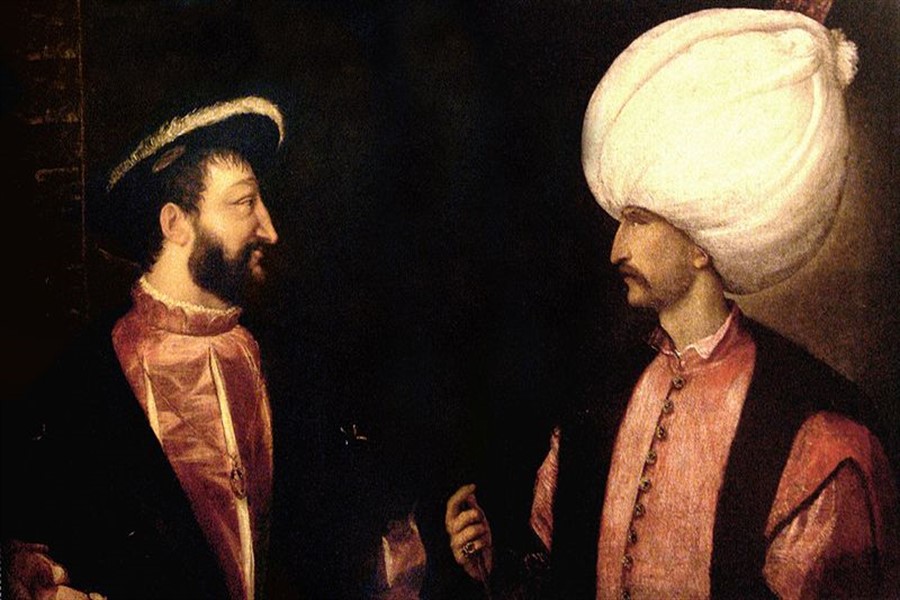
The relationship between Türkiye and France is no ordinary diplomatic connection. Official relations between the two countries date back to the late fifteenth century under the Ottoman Empire. The alliance formed between Suleiman the Magnificent and King Francis I of France against the Habsburg Empire was one of the most remarkable partnerships of its era and helped reshape the European balance of power. With the capitulations granted in 1535, France became the most privileged European state within the Ottoman Empire. One of the legal and political foundations of relations during the republican era was the Ankara Agreement of 20 October 1921, signed during Türkiye’s War of Independence.
Throughout this long history, Türkiye and France have at times been strategic partners and at others fierce rivals. Similar fluctuations were visible during the recent republican period. Jacques Chirac cautiously supported Türkiye’s membership of the European Union while also arguing that it should be submitted to a referendum in France. Despite this, political dialogue between Ankara and Paris was largely preserved during his presidency. Nicolas Sarkozy’s arrival at the Élysée marked a clear rupture. Sarkozy openly argued that Türkiye had no place in the European Union and blocked progress on several negotiating chapters.
Relations partially normalised under François Hollande. His visit to Türkiye in 2014 was the first official visit by a French president in twenty-two years. That same year, the two countries established a framework for strategic cooperation. This normalisation did not, however, translate into full French support for Türkiye’s accession to the European Union. It mainly represented a softening of the rigid and exclusionary approach adopted during the Sarkozy era.
Under Macron, differences of interest became more visible and increasingly personal. Türkiye’s military operations in northern Syria, the two countries’ support for opposing sides in Libya, disputes over maritime jurisdiction in the Eastern Mediterranean and France’s backing for Greece and the Republic of Cyprus repeatedly brought Ankara and Paris into confrontation. When Macron declared in 2019 that NATO was experiencing “brain death,” he was not referring solely to the United States’ gradual disengagement from Europe. His statement also reflected French criticism of Türkiye for acting in Syria without coordinating with its allies.
Tensions reached their peak in 2020. Ankara and Paris exchanged serious accusations over Libya and the Eastern Mediterranean. Following a war of words between Macron and Erdoğan, France recalled its ambassador from Ankara for consultations. During the same period, Paris signed a defence agreement with Greece containing a mutual assistance clause. The sale of 24 Rafale fighter jets and frigates to Athens was interpreted in Ankara not simply as a commercial transaction, but as an attempt to establish a military counterweight against Türkiye in the Eastern Mediterranean.
France’s relations with the Republic of Cyprus also deepened during this period. The defence agreement between Paris and Nicosia entered into force in 2020, and the two countries elevated their ties to the level of a strategic partnership in 2025. As the French and Cypriot navies conducted regular exercises, France became one of the Republic of Cyprus’s leading arms suppliers.
Political tensions, however, never completely severed economic ties. Trade in goods between France and Türkiye reached a record €23.8 billion in 2025. Military cooperation between the two countries also began to revive gradually from 2022 onwards. In other words, while political rhetoric hardened, economic interdependence and security contacts continued quietly.
What Is Drawing Paris Closer to Ankara Is Not Choice, but Necessity
The first reason behind the current rapprochement is the profound transformation of Europe’s security environment. The war in Ukraine, the United States’ tendency to reduce its burden in European defence, regional tensions centred on Iran and Europe’s accelerating rearmament programme have made Türkiye a far more important actor for Paris than it was in the past. France advocates “European strategic autonomy” on the one hand, while confronting Europe’s shortfalls in unmanned aerial vehicles, ammunition, air defence and rapid production capacity on the other. It was no coincidence that the NATO Summit in Ankara centred on the need for Europe to assume greater responsibility for its own security.
Türkiye stands out precisely in these areas. With its large armed forces, its geographical position stretching from the Black Sea to the Middle East, its expanding defence industry and its battle-tested unmanned aerial vehicles, it is seen not only as one of NATO’s major military powers, but also as a partner capable of helping close Europe’s production gaps. As Turkish defence companies conclude agreements in European countries such as Poland, Romania, Portugal and Spain, Baykar has acquired Piaggio Aerospace in Italy and established a strategic joint venture with Leonardo to produce unmanned aerial vehicles together.
Spain’s €2.6 billion agreement with Türkiye for 30 HÜRJET training aircraft is part of the same trend. European countries no longer see Türkiye merely as a market to which weapons can be sold, but as a defence industry hub with which joint production is possible. For France to remain outside this competition would have been incompatible with its ambition to shape the future of European defence.
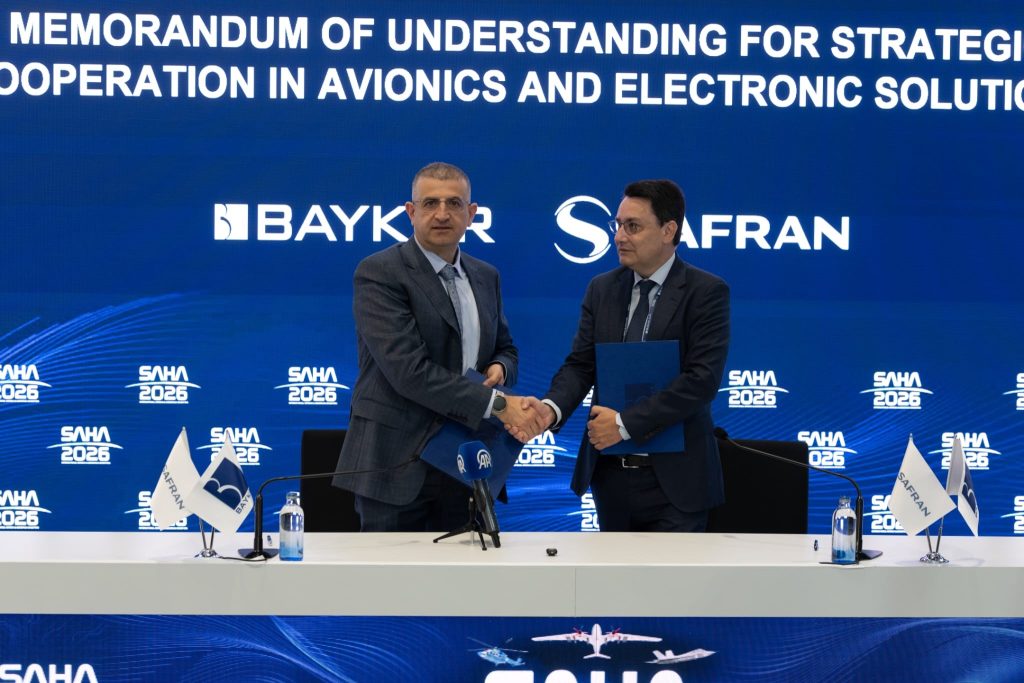
The strategic partnership signed between Baykar and the French company Safran in May 2026 is therefore highly significant. The agreement does not merely envisage the sale of French components for Turkish unmanned aerial vehicles. It includes the joint development of optronic sensors, navigation systems and guided weapons capabilities, the integration of Safran’s Euroflir system into the Bayraktar TB2 and the joint marketing of the resulting solutions on global markets. This is a concrete step showing that the French defence industry recognises the international strength of Turkish platforms.
The shift in the SAMP/T file is even more striking politically. Türkiye, France and Italy launched joint work on long-range air defence in 2017 and 2018. The process was later halted because of tensions in Syria, Libya and the Eastern Mediterranean, with Paris serving for years as the main political obstacle to a potential sale. France now appears open to such a deal, and Macron has confirmed that technical work is continuing. No final agreement has yet been reached. Joint production, technology sharing and objections from Greece and the Republic of Cyprus remain sensitive issues. Even so, France’s movement from an outright rejection to the negotiating stage represents a significant transformation in itself.
Macron’s visit to Syria is another sign of this new realism. He became the first European Union head of state to visit Syria after the fall of Bashar al-Assad. He travelled to Damascus with representatives of French companies and investors, with reconstruction, energy, transport and the restoration of diplomatic relations on the agenda.
Yet it is difficult for France to establish lasting influence in the new Syrian order without taking Türkiye into account. Ankara is one of the decisive actors in Syria’s security, the new administration’s relations with the outside world, the border regions and economic reconstruction. The fact that Macron travelled to Ankara immediately after his visit to Damascus and held a lengthy meeting with Erdoğan is significant in this respect. The two visits taking place in succession suggest that Paris has realised it can no longer treat the Syrian and Turkish files as separate issues.
Macron once presented Türkiye’s military operations in Syria as a symbol of the lack of coordination within NATO. Today, he attends a NATO Summit in Ankara to discuss the future of European defence and negotiates air defence cooperation with Türkiye. What has changed is not France’s fundamental interests, but its calculation that working with Türkiye has become necessary to protect them.
Ultimately, Türkiye and France have much to gain by acting together. France can offer advanced sensors, missile technologies, engine systems, financing and access to the European market. Türkiye can provide high production capacity, competitive costs, battle-tested platforms, a broad export network and strategic access between Europe and the Middle East. There is considerable common ground in areas such as Ukraine’s security, the Black Sea, Syria’s reconstruction, Africa, energy corridors and air defence.
Serious obstacles nevertheless remain. France’s defence partnerships with Greece and the Republic of Cyprus, differences of interest in Libya and the Eastern Mediterranean, competition for influence in Africa and the lingering mistrust between the two leaders will not disappear easily. Anti-Türkiye reflexes in French domestic politics, the Armenian question, debates over secularism and Islam, and deeply rooted resistance to Türkiye’s membership of the European Union will also continue to limit Paris’s room for manoeuvre.
For this reason, it is more accurate at this stage to describe what is happening as a pragmatic rapprochement rather than a fully fledged strategic partnership. Paris does not accept all of Ankara’s policies, and Ankara has not adopted France’s regional preferences. But France is not moving closer to Türkiye because Ankara has abandoned its own course. Paris is changing direction because it has realised that the cost of ignoring Türkiye’s regional weight is steadily increasing.