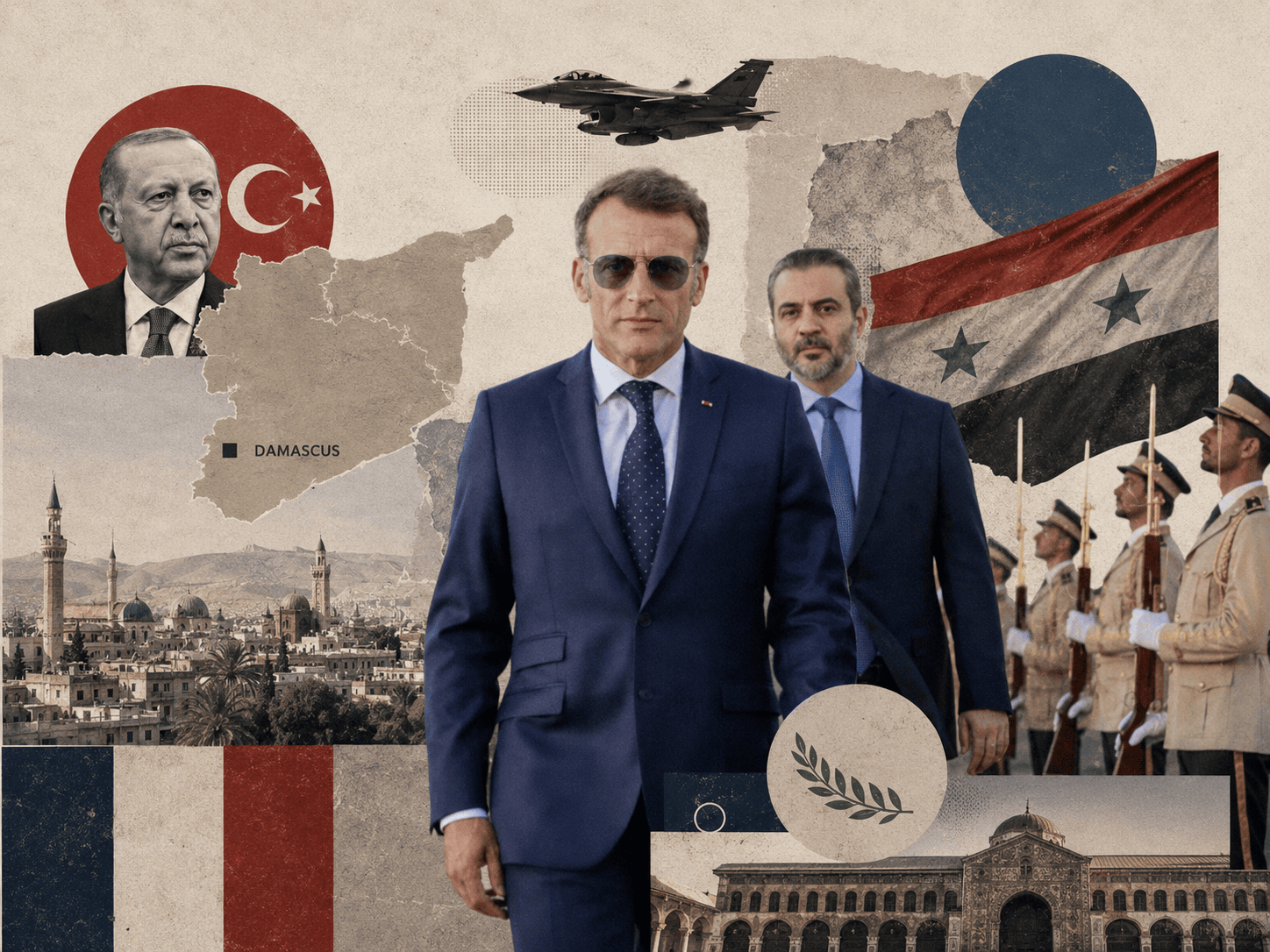

Emmanuel Macron’s visit to Damascus carried significance far beyond a symbolic gesture intended to demonstrate France’s solidarity with the Syrian people. The French president became the first European Union leader to visit Syria since the fall of the Assad regime, and he was accompanied not only by diplomats but also by executives from French companies operating in the energy, transport and infrastructure sectors.
The most realistic answer to the question of why Macron went to Syria is therefore clear: France does not want to be left outside the room as a new Syrian order takes shape.
After years of war, Syria is not merely a country in need of reconstruction. With its ports opening onto the Eastern Mediterranean, its land routes extending towards Iraq and the Gulf states, its energy corridors and its regional trade networks, Syria is a strategic transit hub. Rebuilding its state institutions, electricity infrastructure, transport networks, financial system and healthcare services will create an economic market worth billions of euros.
By becoming involved at an early stage, Paris hopes to secure opportunities for French companies, strengthen European influence in Damascus and compensate for France’s loss of influence in the Middle East. The emphasis placed during the visit on healthcare, aviation, finance and infrastructure, together with the interest shown in Syria by major companies such as TotalEnergies and CMA CGM, provides tangible evidence of this approach.
France’s second major objective is security. For Paris, the fight against ISIS, the situation of French nationals in Syria and the prevention of new migration flows towards Europe are matters of direct concern.
The explosions that occurred near the hotel where Macron was staying also demonstrated how critical the security dimension remains. The incident showed that Syria’s return to the international system will depend not only on diplomatic engagement and economic investment, but also on the establishment of lasting stability on the ground.
During the war, France established relations with various local actors in Syria. In the new period, however, Paris recognises the need for direct engagement with the authorities in Damascus. Restoring the functioning of state institutions, preserving the country’s territorial integrity and integrating armed groups into the state system are also among the priorities supported by France.
Some commentators have interpreted Macron’s visit to Damascus as the beginning of a new rivalry between France and Türkiye in Syria. In the past, the YPG issue was one of the most significant sources of disagreement between the two countries. Macron’s proposal to mediate between Türkiye and the YPG even led to diplomatic tensions between Ankara and Paris.
Conditions on the ground in Syria, however, are now entirely different. The launch of the “Terror-Free Türkiye” process and the agreement reached between the Damascus authorities and the YPG, providing for a ceasefire and gradual integration, have created a new landscape.
Under these circumstances, maintaining close dialogue with Türkiye is also in France’s own interest if it wants to play an influential role in Syria.
Türkiye shares a long border with Syria. Its military presence on the ground, its political influence in Damascus, its relations with opposition groups and its decisive role in border security and the return of refugees make Ankara an indispensable actor in the Syrian equation. European countries may pursue diplomatic and economic initiatives, but Paris also knows that a security order on the ground cannot be established by disregarding Türkiye.
France’s diplomatic network, its influence within the European Union and the economic contribution it can make to Syria’s reconstruction are equally important to the country’s stabilisation. In this new period, the capabilities of Türkiye and France may therefore complement one another rather than compete.
Macron’s meeting with President Erdoğan at the NATO Summit in Ankara immediately after his visit to Syria is noteworthy in this respect. The fact that they discussed defence, Ukraine and the Middle East alongside bilateral relations suggests that France wants to address regional issues with Türkiye on a more pragmatic basis. The renewed progress in technical work between Türkiye, France and Italy on the SAMP/T air defence system during the same period is another indication of this pragmatic shift in relations.
France cannot, of course, be expected to endorse all of Türkiye’s choices, nor can Ankara and Paris be expected to agree on every issue. Those differences, however, do not need to outweigh their shared interests.
France’s main objective in Syria is not to establish a new balance against Türkiye, but to secure an economic and political role in the country’s future, contain security threats and preserve its influence in the Middle East. Türkiye, for its part, can benefit from France’s influence within the European Union, its economic capacity and the contribution it can make to Syria’s reintegration into the international system.
Macron’s visit to Syria should therefore be seen not as the beginning of a new rivalry between Türkiye and France, but as a more pragmatic recognition of regional realities.
France wants to return to Syria. But for that return to become possible, it needs balanced cooperation with Ankara that recognises Türkiye’s influence on the ground, rather than confrontation. In other words, Paris knows that, in this new era, the road to Damascus runs through Ankara.