
The partnership developing between Türkiye and Syria in the post-Assad era is entering a new phase. Following Foreign Minister Hakan Fidan’s meeting in Ankara with his Syrian counterpart, Asaad Hassan al-Shaibani, the two countries signed a memorandum of understanding. The issues presented at the joint press conference offered important insights not only into the future of bilateral relations, but also into the Middle East’s emerging geoeconomic transformation.
Hakan Fidan’s statement that “it is impossible to view the prosperity and stability of Türkiye and Syria separately. What lies between us is not merely a border of more than 900 kilometres, but also a shared history, a shared culture and a shared future” encapsulates Ankara’s changing perception of Damascus. Türkiye no longer views Syria solely through the prism of security risks; it is increasingly positioning the country as one of the central pillars of regional economic integration.
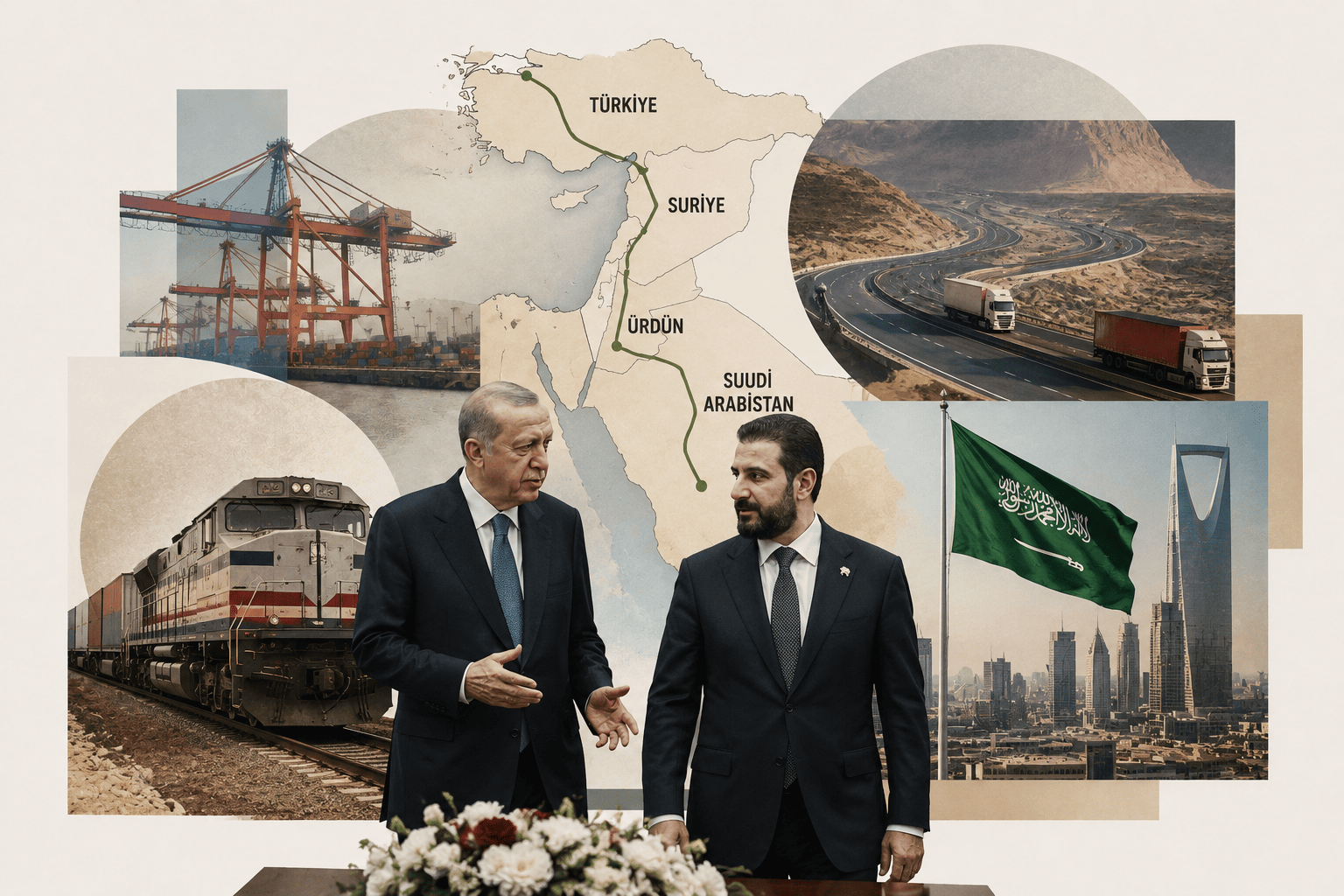
The clearest expression of this approach was the announcement of a road and railway initiative that would establish an uninterrupted connection between Türkiye, Syria, Jordan and Saudi Arabia. Although the project may initially appear to be a conventional transport scheme, it is in fact part of a broader transformation in Türkiye’s Middle East strategy. By complementing its security-oriented regional policies with economic connectivity, Ankara is seeking to construct a new geoeconomic architecture.
Syria: Türkiye’s Strategic Gateway to the Gulf
For nearly fifteen years, Türkiye’s Syria policy was shaped primarily by unavoidable security concerns, including counterterrorism, border security and irregular migration. Today, however, Ankara’s priorities are evolving. From Türkiye’s perspective, Syria is no longer merely a neighbouring country that needs to be stabilised; it is becoming a strategic transit hub connecting Türkiye to the Gulf through Jordan and Saudi Arabia.
The proposed project therefore carries significance far beyond the creation of a new transport route linking four countries. Its objective is to integrate roads, railways, border crossings, customs systems and logistics hubs into a single economic network. In doing so, it aims to restore trade routes disrupted by years of conflict and revive regional commercial networks.
This strategy is based on the same geoeconomic logic as the Iraq Development Road Project, which Türkiye has actively supported in recent years. Rather than pursuing a series of disconnected infrastructure initiatives, Ankara now seeks to build complementary trade corridors extending from Iraq to Syria and onward to Jordan and Saudi Arabia. Through this network, Türkiye aims to become one of the principal junctions of the overland trade routes linking Europe and the Gulf.
A New Land Corridor That Could Reduce Dependence on Hormuz
What makes the initiative strategically significant is that it does not merely seek to revive the historic Hejaz Railway. The proposed system envisages integrating modern railway lines, international highways, logistics centres and customs infrastructure into a single transport network. In other words, the project is not simply a railway scheme, but a comprehensive land-based logistics corridor connecting the Gulf to the Eastern Mediterranean.
The corridor’s geopolitical importance becomes even clearer when viewed against the mounting risks facing global trade. Today, approximately one-quarter of the world’s seaborne oil shipments and around one-fifth of global liquefied natural gas trade pass through the Strait of Hormuz. Tensions between Iran and the United States, security challenges in the Red Sea and the growing vulnerability of maritime trade routes are making alternative overland corridors increasingly valuable.
Although the Türkiye-led route would not replace maritime transport, it could provide a safer, faster and more predictable logistics option between the Gulf and the Eastern Mediterranean. Encompassing a combined population of approximately 160 million people and an economic output exceeding $2.8 trillion, this emerging axis could become one of the Middle East’s largest economic integration projects if successfully implemented.
It is no coincidence that the Iraq Development Road Project, Syria’s reconstruction and the Türkiye-Syria-Jordan-Saudi Arabia corridor have all moved onto the regional agenda within the same period. Ankara aims to become not only an actor that helps establish security in the Middle East, but also one that reshapes the region’s trade routes and economic geography.
Should this strategy succeed, Syria could become Türkiye’s most important overland gateway to the Gulf, giving rise to a new axis in the Middle East’s geoeconomic balance.