SAHA EXPO is no longer just another defence exhibition. This year, Istanbul welcomed more than 1,700 exhibitors, over 150,000 visitors, and 192 official delegations from four continents, turning the event into one of the world’s leading defence industry gatherings. With more than 88,000 highly skilled jobs, a project portfolio exceeding $14.3 billion, and export capacity above $8 billion, SAHA has established itself as Europe’s largest defence industry platform.
Touring the exhibition halls, Turkish Vice-President Cevdet Yılmaz summed up the country’s ambitions in a single sentence: “A country that does not possess its own defence industry cannot pursue an independent foreign policy.”
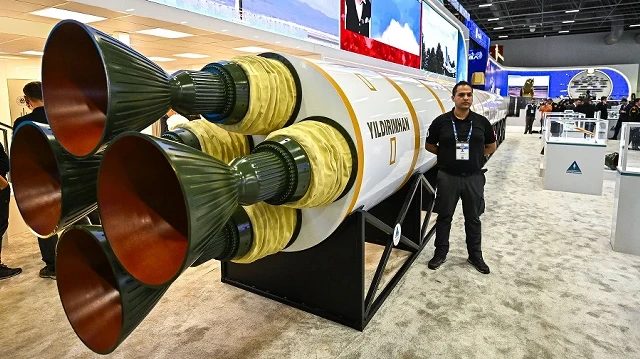
The YILDIRIMHAN embodies that vision precisely. Its name, inscribed in gold lettering along its white body, was accompanied by Atatürk’s signature at the front and the imperial seal of Yıldırım Bayezid on its flank. More than simply a weapon, the missile appeared as a symbol of technological and strategic sovereignty.
Until now, only a handful of states, including the United States, Russia, China, France, the United Kingdom, India, Israel, Iran, and North Korea, were regarded as capable of developing intercontinental-range ballistic missiles. With the YILDIRIMHAN, Ankara is now openly signalling its intention to join that exclusive club.
Athens Stunned, Tel Aviv on Alert
The moment the missile was unveiled, reactions poured in from across the world.
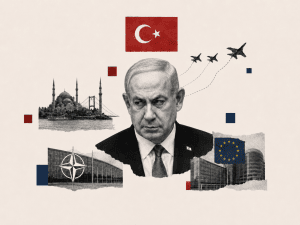
In Israel, the newspaper Maariv described the YILDIRIMHAN as an “apocalyptic monster”, while Kikar wrote more bluntly that the new missile now placed the entirety of Israeli territory within range of a Turkish strike. Channel 7, meanwhile, argued that Turkey had acquired capabilities previously reserved for superpowers alone.
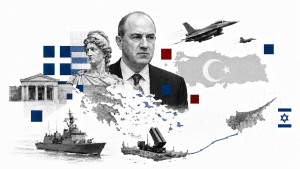
The Greek reaction was equally dramatic. Media outlets in Athens ran headlines referring to “shock in Greece and admiration in Israel”. The publication Economico described the system as “a major qualitative leap in Turkey’s military capabilities”, one capable of reshaping the regional strategic balance.
One Greek defence website, however, pointed out an important nuance: for Greece, the YILDIRIMHAN does not necessarily represent an entirely new threat, since Turkey already possesses shorter-range systems capable of striking Greek territory. The capitals now forced to reassess their strategic calculations, it argued, are those farther afield, beginning with Tel Aviv.
One crucial point should nevertheless be remembered: the YILDIRIMHAN remains only a prototype at this stage. Specialists estimate that a ballistic missile of this class would generally require between eight and ten years before entering full operational service. For now, therefore, it is above all a demonstration of strategic intent. Yet its political and psychological impact is already unmistakable.
A Transformation Two Decades in the Making
The YILDIRIMHAN did not emerge overnight. It is the culmination of a profound transformation within Turkey’s defence industry.
In 2002, domestic production accounted for no more than 20% of the sector. That figure rose to 73% in 2022, then 80% in 2023, before reaching 83% in 2024. Exports have followed the same trajectory: in 2024, Turkish defence and aerospace exports rose by 29%, reaching a record $7.1 billion, with sales to more than 180 countries. Ankara has now set a target of $13 billion by 2026.
Behind this rise lies a methodical long-term strategy. Having experienced multiple embargoes and supply crises in the past, Ankara made industrial self-reliance a state priority. Domestic production is no longer viewed as an option, but as a central pillar of Turkish sovereignty.
From the TB2 drone to the KAAN fighter jet, and from the Tayfun missile to the YILDIRIMHAN, an entire new generation of military systems now reflects that policy.
Today, the defence industry is far more than a security issue alone: it has become one of the driving forces behind Turkey’s technological ascent and one of the foundations of its diplomatic autonomy.
SAHA 2026 offered a snapshot of that transformation. And the YILDIRIMHAN was unquestionably its most striking symbol.