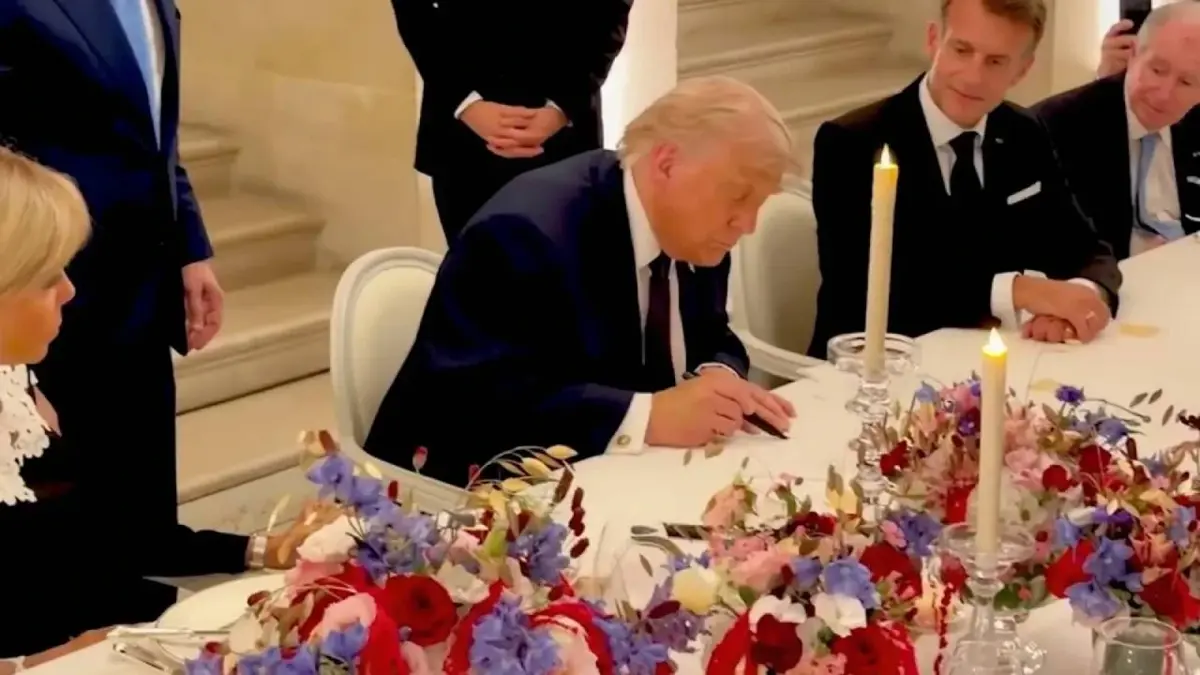

U.S. President Donald Trump signed the agreement reached with Iran, bringing the 107-day war to an end, at the Palace of Versailles. At first glance, this choice seems entirely natural: one of the world’s most famous palaces, a major diplomatic agreement, and leaders posing in victory.
But Versailles is no ordinary place.
Versailles is where one of the most controversial treaties in modern history was signed. In 1919, Germany was brought to the negotiating table there, forced to make heavy concessions, and went down in history as the side that had officially lost the war. The agreement signed that day did not bring lasting peace to Europe. On the contrary, according to many historians, it laid the psychological and political foundations for the Second World War.
That is why, for many people, Versailles evokes not victory, but defeat.
And precisely for that reason, one cannot help but ask:
Why was Trump at Versailles?
Or more accurately, why was Versailles specifically chosen?
Of course, there may have been diplomatic and protocol-related reasons for this choice. But in international politics, symbols are sometimes more powerful than the texts themselves.
It is difficult to believe that Macron chose, by chance, one of the most heavily charged symbols in European history. For that reason, seeing Versailles merely as an aesthetic backdrop would be to miss part of the message.
Because the image that emerges is striking.
Trump is signing an agreement he presents to the public as a major diplomatic victory in a place remembered in history as the site where one side made concessions and was forced to step back.
The Iranian leadership presents the agreement as its own success.
Washington presents it as a victory.
But the historical memory of Versailles whispers a very different story.
Perhaps the real message was not directed at Iran, but at Trump.
Perhaps the symbolic message was this:
“You may present this agreement as a victory. But history may not always agree.”
After all, it is true that at the end of the war, Iran accepted certain restrictions on its nuclear program. But Washington also had to end the conflict, show flexibility on sanctions, and return to the negotiating table. In other words, what stands before us is not an absolute victory, but a compromise shaped by mutual concessions.
And that is precisely why the choice of Versailles is so striking.
Because in 1919, those sitting in that room also believed that history would record them as the victors.
Years later, however, history delivered a very different verdict.
Perhaps today’s agreement will truly mark the beginning of a new period of stability in the Middle East.
Or perhaps, when people look back years from now, it will not be remembered as a day when everyone thought they had won, but as the beginning of a very different process.
One thing is certain:
At Versailles, signing an agreement is not enough to declare victory; sooner or later, history decides what that signature truly meant.