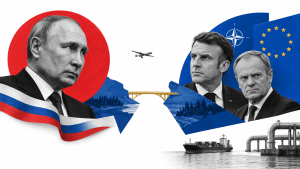
Over the past several weeks, a series of increasingly unsettling reports has emerged from and around Russia. None of them, taken in isolation, is enough to conclude that a wider war is imminent. Taken together, however, they point to a European security environment that is changing at remarkable speed.
Perhaps the most unusual development was CIA Director John Ratcliffe’s visit to Moscow. For the head of the CIA to travel to Russia in the middle of an ongoing war was significant in itself. The full substance of Ratcliffe’s talks with Russian intelligence officials has not been made public. According to US media reports, however, one of Washington’s messages was clear: Moscow should not contemplate any military action against NATO territory. Although the Trump administration sought to play down the significance of the visit, sources cited by Reuters confirmed that the possibility of Russian operations against NATO was among the issues discussed.
The visit came amid mounting reports that Russia is preparing for the possibility of a larger and more protracted war. According to The Wall Street Journal, citing Western intelligence officials, the Russian military has been examining how hundreds of thousands of additional troops could be mobilized, housed, equipped, and assigned to units should a new mobilization be ordered. The fact that some of these preparations have reportedly been tested in Kaliningrad is particularly noteworthy. The Kremlin has not formally announced a new mobilization. Yet these exercises suggest that Moscow is not planning on the assumption that the war will end soon. On the contrary, it appears to be preparing for the possibility of a longer and more demanding conflict.
The return of the nuclear question is part of the same picture. In recent weeks, reports have suggested that some circles in Moscow are once again discussing the possible use of tactical nuclear weapons should the war deteriorate significantly from Russia’s perspective. There is currently no evidence that Russia is making concrete preparations for nuclear use. But the fact that the nuclear option is appearing more frequently in political and military debate is itself indicative of how far Europe’s security environment has shifted.
Against this backdrop, the central question is no longer simply whether Russia intends to intensify its campaign in Ukraine. It is whether Moscow is also beginning to treat the possibility of a direct confrontation with NATO as a serious contingency.
Poland Is Emerging as the New Focal Point of Russia-NATO Tensions
Poland’s growing prominence in this confrontation is no coincidence.
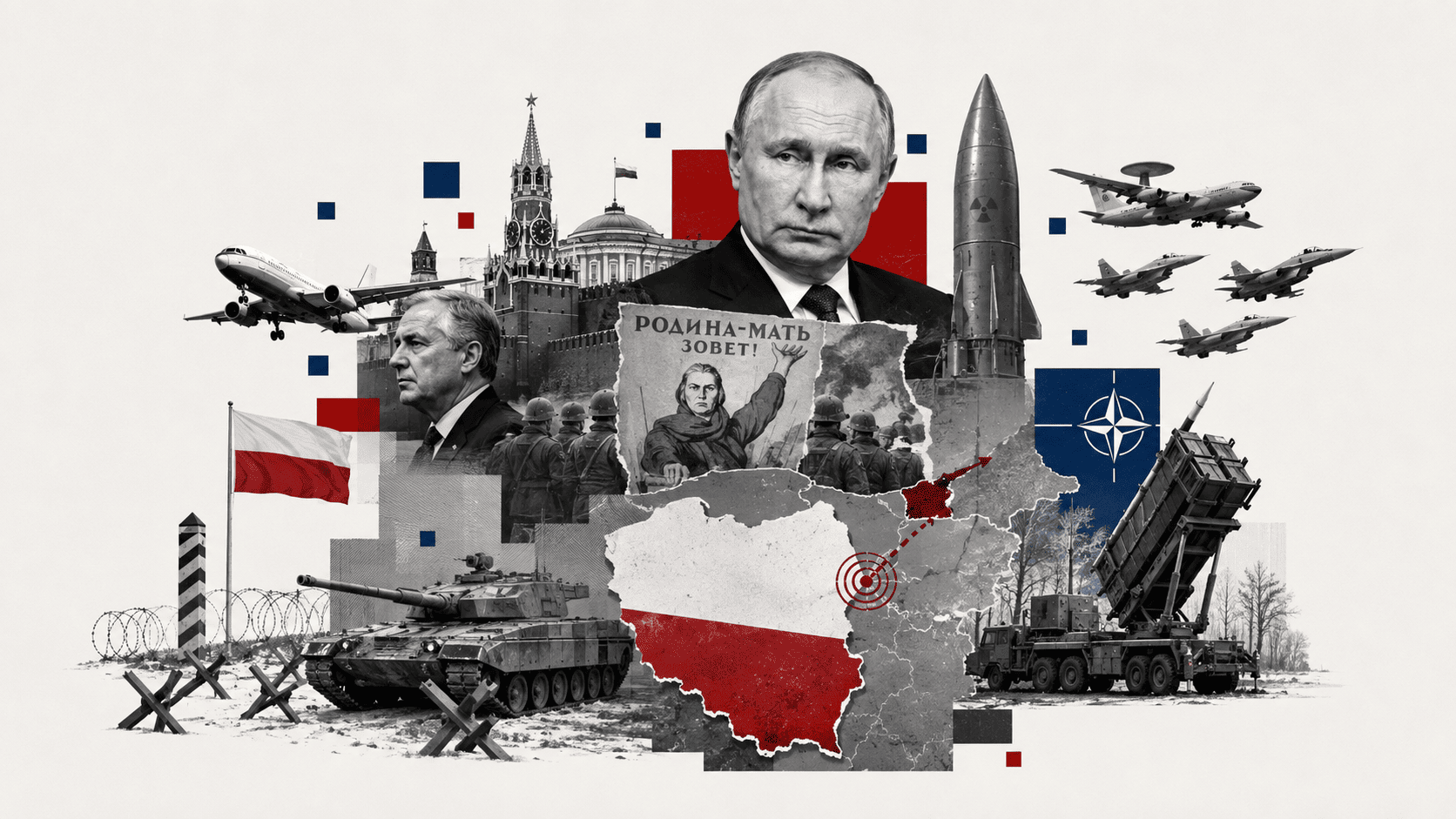
The country borders Belarus to the east and Russia’s Kaliningrad exclave to the north. More importantly, the roughly 100-kilometre Suwałki Corridor between Poland and Lithuania is the only land link connecting the Baltic states to the rest of NATO territory. In the event of a Russia-NATO conflict, severing this corridor could effectively cut Estonia, Latvia, and Lithuania off from the alliance by land.
This is why Poland is becoming one of the most heavily fortified countries in Europe. Warsaw is constructing its so-called Eastern Shield, a defensive network stretching for roughly 800 kilometres along its borders with Russia and Belarus. Anti-tank ditches, concrete barriers, surveillance systems, and new defensive positions are being installed. Since June, German troops have also been working alongside Polish forces on sections of the project. The German military has explicitly stated that the Suwałki Corridor is part of these efforts.
NATO’s military presence in the same region is also becoming more visible. In August, US and Norwegian fighter aircraft, NATO AWACS early-warning planes, aerial refuelling tankers, and electronic warfare aircraft took part in an air exercise near Kaliningrad. Estimates suggest that between 25 and 50 aircraft were involved. NATO describes the exercise as planned training. But its location carries an unmistakable message: the alliance is now openly rehearsing how a large-scale confrontation around Kaliningrad might be managed.
None of this means that Russia is preparing to invade Poland. An overt attack on Poland would represent a fundamentally different threshold from the war in Ukraine. It could trigger NATO’s Article 5 and place Russia in direct confrontation with the United States, Germany, France, the United Kingdom, and the rest of the alliance.
Yet a full-scale invasion is not necessarily the most immediate danger.
Western intelligence circles are increasingly focused on the possibility that Russia could seek to test NATO through more limited means: a contained military operation, sabotage, cyberattacks, airspace violations, or hybrid actions designed to preserve ambiguity over responsibility. One of the concerns surrounding the CIA director’s visit to Moscow appears to have been precisely this: that the Kremlin might attempt to probe NATO’s political resolve.
This leads to another uncomfortable question for the alliance. NATO is substantially stronger than Russia in aggregate military capacity, aircraft, manpower, and economic resources. But its readiness for a prolonged, high-intensity missile war is far less certain. An Associated Press investigation published this week reported that some US officials consider American Patriot interceptor stocks in Europe to be below critical levels. Patriot systems are among Europe’s most important defences against Russian ballistic missiles. In other words, NATO’s overall deterrent remains formidable, but the risk of ammunition shortages after the first weeks of a high-intensity conflict cannot simply be dismissed.
There is, for now, no evidence that Moscow has decided to attack Poland. But the developments of recent months make one thing increasingly clear: Europe no longer treats such a scenario as unthinkable. Russia is testing the infrastructure for another mobilization, Poland is fortifying its eastern frontier, NATO is preparing for possible conflict around Kaliningrad, Washington is maintaining direct channels with Moscow, and the nuclear option is once again being discussed in serious terms.
The war in Ukraine has already moved far beyond a bilateral confrontation between Kyiv and Moscow. What is now being tested is not only Ukraine’s future, but Europe’s security architecture, NATO’s deterrent credibility, and the limits of how far Russia believes it can push against the West.
The greatest danger may therefore not be Russian tanks suddenly crossing into Poland, but a smaller incident spiralling beyond anyone’s control. A missile landing on Polish territory, a military confrontation in the Baltic Sea, a provocation around Kaliningrad, or a major act of sabotage against NATO infrastructure could transform a political crisis into a military one within hours.
It is still too early to speak of a Third World War. But Europe is entering a period in which both Russia and NATO are making concrete preparations for a confrontation that, only a few years ago, was largely regarded as a theoretical possibility.
In other words, no decision for a wider war may yet have been taken. But the conditions that could make such a war possible are gradually falling into place.