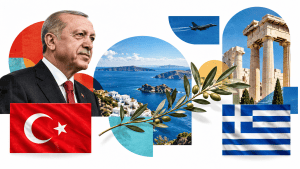
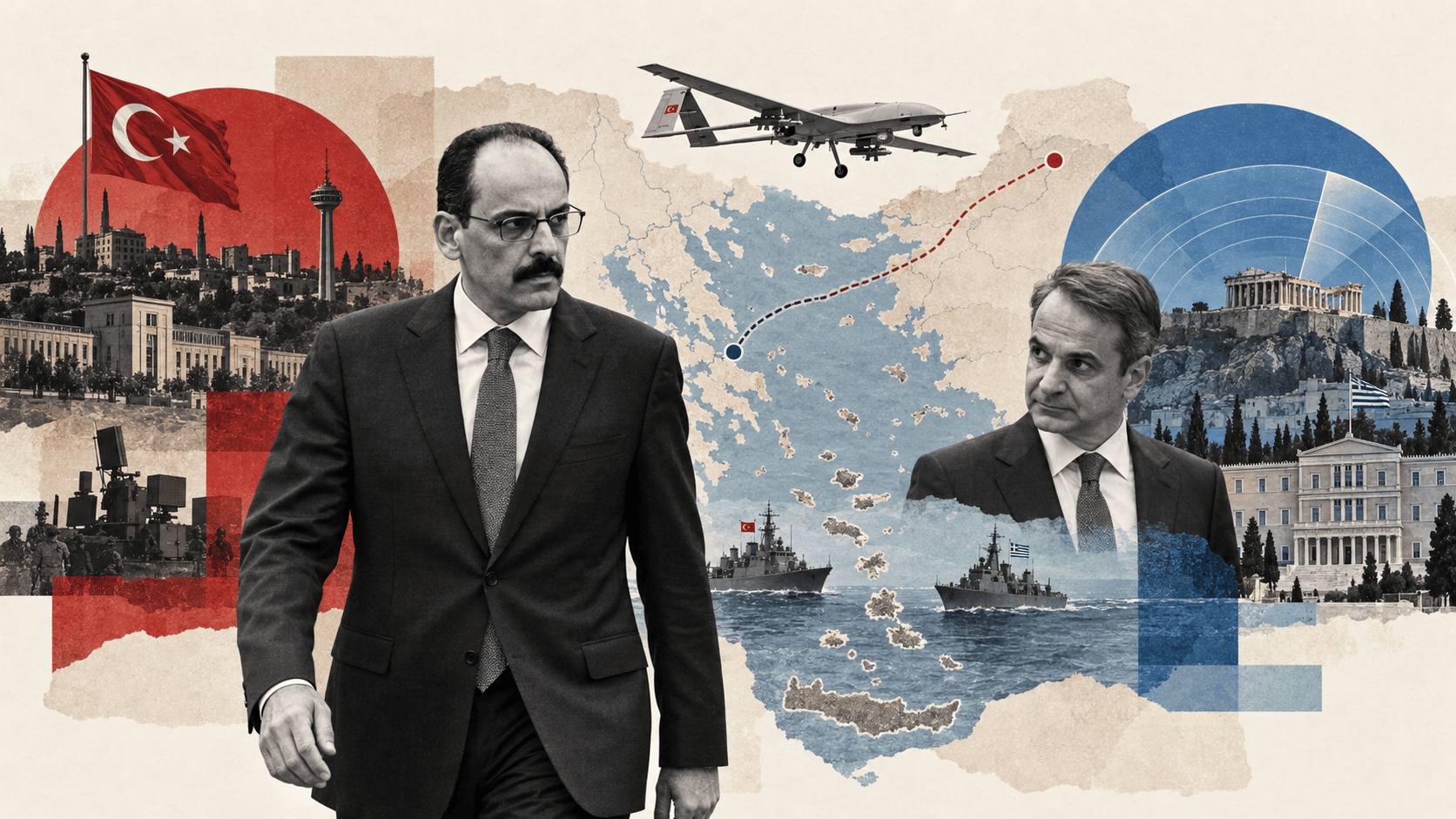
The discreet visit to Athens last week by İbrahim Kalın, head of Türkiye’s National Intelligence Organization (MİT), for talks with Themistoklis Demiris, director of Greece’s National Intelligence Service (EYP), illustrates just how sensitive relations between the two countries have become. The meeting was not announced in advance and only emerged in the press several days later, triggering accusations of “secret diplomacy” in Athens.
Greek media also reported that Kalın and Demiris subsequently travelled to the Maximos Mansion, where the Turkish intelligence chief was allegedly received by Greek Prime Minister Kyriakos Mitsotakis. Athens, however, has not officially confirmed this second meeting.
Even the publicly confirmed agenda suggests that this was far more than a routine exchange between intelligence officials. In addition to security in the Aegean and the Mediterranean, NATO, irregular migration, terrorism and organised crime, the discussions covered the US-Iran war and developments in Gaza, Syria, Lebanon and Libya. The two intelligence services also agreed to strengthen their cooperation on regional issues.
Kalın’s visit appears to have conveyed two messages from Ankara at once: Türkiye does not want an escalation, but neither will it allow its interests in the Aegean to be gradually eroded.
Dialogue Behind Closed Doors, Surveillance over the Aegean
Reports that emerged shortly after Kalın’s visit revealed the operational dimension of this dual-track policy. An unnamed Greek official told Kathimerini that Turkish Bayraktar drones had been conducting surveillance flights over the northeastern Aegean almost daily since mid-August.
According to Greek authorities, the drones take off from the Çanakkale area and fly at an altitude of approximately 17,000 feet over the marine parks recently declared by Türkiye, particularly the zone between Lemnos and Samothrace. The official said the flights appeared to be surveillance missions, while acknowledging that the Bayraktars were not harassing commercial aircraft or systematically entering Greek airspace. When a violation is detected, Greek F-16s are reportedly scrambled to intercept them.
A Bayraktar TB2 flight over the eastern Aegean on the night of 3 September also attracted extensive coverage in the Greek press. Ta Nea interpreted these nocturnal missions as intelligence, surveillance and reconnaissance operations designed to monitor Greek naval movements, military deployments on the islands and the response times of Greek radar systems. The newspaper also noted that scrambling an F-16 to intercept a relatively inexpensive drone creates a costly cycle of attrition for Greece.
These developments cast Athens’ €3 billion Achilles Shield agreement with Israel in a different light. Greece is building a multilayered air-defence network based on Israeli systems to counter missiles, combat aircraft and drones. Although official statements do not explicitly identify Türkiye as the target, it is no secret that threats perceived as emanating from Ankara are central to the system’s strategic rationale.
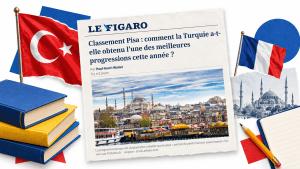
In its analysis of mounting tensions in the Aegean, Le Figaro links the name “Achilles Shield” to Homer’s Iliad. According to the French newspaper, Athens is forging a “deterrent suit of armour” against a Türkiye it regards as “increasingly provocative.” Viewed from France, Greece is portrayed as the party defending itself, while Türkiye is cast as the power applying pressure.
But this one-sided interpretation captures only part of the dispute. From Ankara’s perspective, the militarisation of the Aegean islands, the strengthening of the Israel-Greece-Greek Cypriot military axis, and unilateral marine park declarations in disputed waters are not defensive measures. They are steps intended to restrict Türkiye’s strategic room for manoeuvre. Every move Athens presents as a security precaution is interpreted in Ankara as an attempt at containment; every Turkish response is then portrayed in Greece as preparation for aggression.
Marine parks have become the latest manifestation of this mutual distrust. After Greece established protected areas in the Ionian and Aegean seas in 2025, Türkiye declared two national marine parks in the northern Aegean and eastern Mediterranean on 16 August 2026. Athens argues that the Turkish parks encroach upon its continental shelf and sovereign rights. Ankara, by contrast, believes Greece is using environmental protection as a vehicle for creating faits accomplis in contested waters.
When this dispute is combined with the militarisation of islands that Ankara maintains should retain demilitarised status, disagreements over airspace and territorial waters, competing continental shelf and exclusive economic zone claims, and the unresolved Cyprus question, an exceptionally fragile security environment emerges in the Aegean.
Closer military ties with Israel are not universally accepted within Greek society either. Public attitudes towards Israel have become markedly more negative since the war in Gaza, prompting protests across the country. Pew Research Center’s 2026 survey likewise showed a sharp deterioration in perceptions of Israel in Greece. Nevertheless, the Mitsotakis government views its defence partnership with Israel as a long-term strategic choice capable of giving Athens an advantage over Türkiye.
This is precisely why İbrahim Kalın’s visit to Athens matters. It does not indicate that trust has been restored between the two countries. On the contrary, it suggests that tensions have become too sensitive to be managed through conventional diplomatic channels alone. Away from the cameras, intelligence chiefs can assess the other side’s real intentions, communicate red lines and prevent a military incident in the Aegean from escalating into a political crisis.
The emerging picture is striking: dialogue continues behind closed doors while drones patrol the skies over the Aegean. Athens is constructing a new shield with Israeli missiles, while Ankara uses Bayraktar drones to monitor its newly declared marine parks. Both countries insist that they are not preparing for war, yet both are expanding their military capabilities in anticipation of the other side’s next move.
A direct war between Türkiye and Greece remains unlikely in the near term. The real danger is not a planned conflict, but a miscalculation: a dangerous interception in the air or an uncontrolled encounter at sea. Kalın’s discreet visit to Athens suggests that both capitals recognise this risk.
The crucial question is whether this confidential channel can evolve into a durable mechanism for de-escalation, or whether it merely represents a brief pause before a much larger storm gathers over the Aegean.