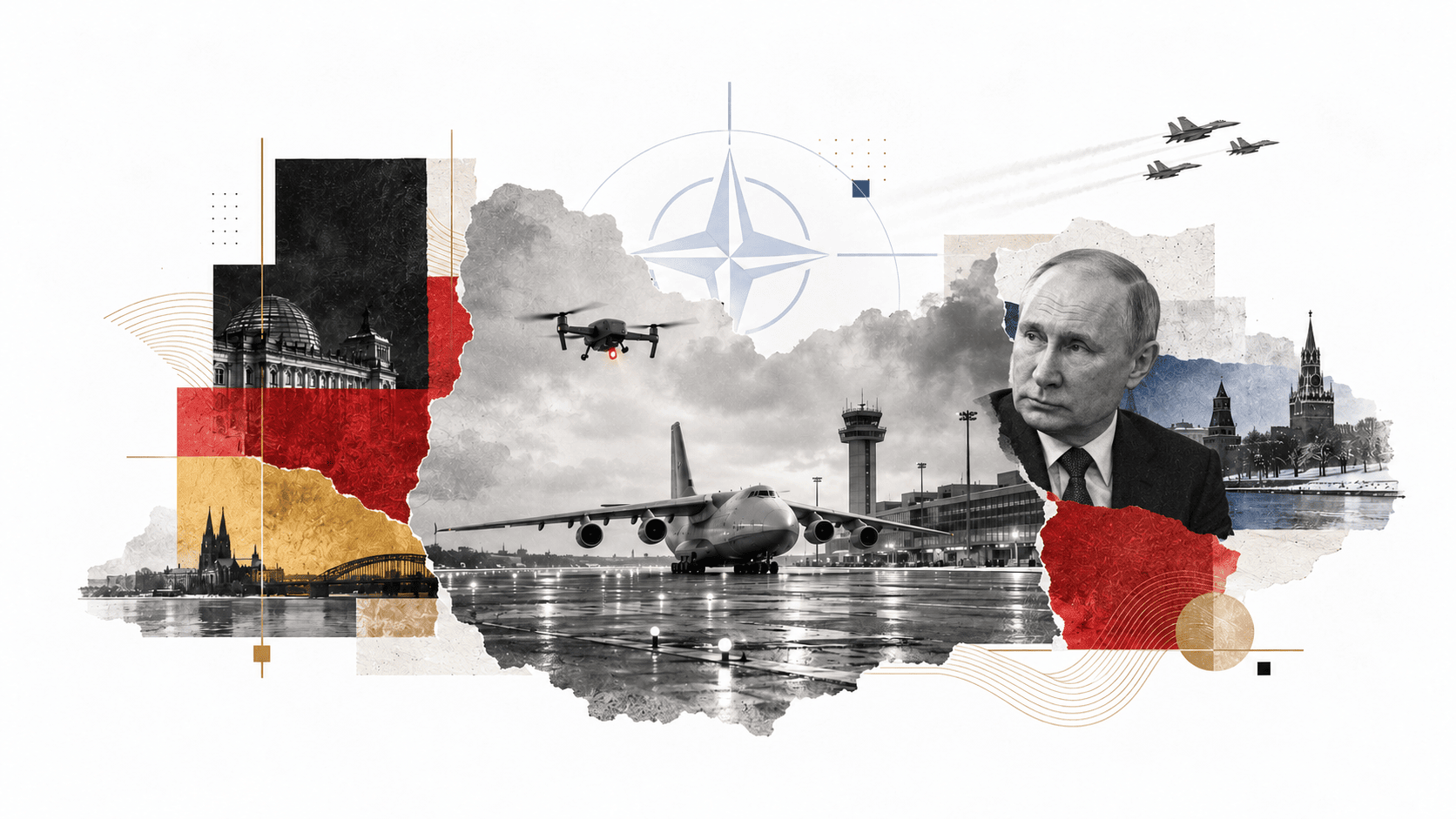
Tensions between Germany and Russia are rising dangerously. At the centre of the crisis is a drone carrying explosives that was discovered near Ukrainian cargo aircraft at Leipzig/Halle Airport on the night of 4 August.
The device failed to detonate because its triggering mechanism did not work. But its location was anything but random. Leipzig/Halle is not only one of Europe’s main cargo hubs; it is also a strategically important transit point for military supplies bound for Ukraine.
One of the Ukrainian aircraft parked near the drone had recently transported ammunition, although German authorities said it was empty at the time of the incident.
After an investigation lasting nearly a month, the German government formally accused Russia of being behind the attempted attack. Berlin says the drone’s configuration, the explosives and the method used resemble previous operations linked to Moscow. German officials also claim to possess intelligence indicating that those involved were acting on behalf of Russian state bodies.
However, Berlin has not made all of that intelligence public. Moscow has seized on this point, rejecting the allegation and accusing Germany of targeting Russia without presenting sufficient evidence.
The confrontation quickly moved into the diplomatic arena. Germany ordered the closure of the Russian Consulate General in Bonn and moved to terminate the activities of the Russian House of Science and Culture in Berlin. Russia retaliated by closing Germany’s Consulate General in St Petersburg and the Goethe-Institut’s operations in the country.
A drone that never exploded has therefore brought relations between two of Europe’s major powers to a new breaking point.
From economic partnership to hybrid confrontation
Germany and Russia were once close economic partners. For decades, Germany benefited from relatively inexpensive Russian natural gas, while Russia gained access to one of Europe’s largest energy markets.
Cheap Russian gas played an important role in supporting the competitiveness of Germany’s chemical, metals and heavy-industrial sectors. German manufacturers used that energy to produce high-value goods for export around the world. The Nord Stream pipelines became the clearest symbol of this mutual dependence.
That model collapsed after Russia’s invasion of Ukraine. Germany was forced to seek more expensive alternatives, driving up energy and industrial production costs.
Germany’s economic difficulties cannot, of course, be blamed on energy alone. Competition from China, the transformation of the automotive industry and weak domestic demand have also played a role. Nevertheless, the loss of cheap Russian gas dealt a serious blow to the country’s industrial model.
That economic discontent is now being reflected in German politics. The Alternative for Germany, or AfD, came first in the Saxony-Anhalt state election with 43.8% of the vote.
This was a regional rather than a federal election, and the party did not win an outright majority. Even so, the result represents an important political turning point.
The AfD has called for sanctions against Russia to be lifted, support for Ukraine to be reduced and Russian energy imports to resume. Its rise may not change Berlin’s foreign policy immediately, but it could increase pressure on the federal government. If Germany’s economic problems continue, arguments in favour of restoring relations with Moscow may gain wider public support. That is also why the election result was welcomed in Russia.
If the German government’s allegations are correct, the purpose of the Leipzig operation was probably not to start a direct war with Germany. It may instead have been intended to raise the cost of supporting Ukraine.
The message to Europe would be clear: if you continue supplying weapons to Ukraine, strategic facilities on your own territory may no longer be safe.
Germany has consequently described the incident as a “hybrid attack.” Hybrid warfare refers to the use of sabotage, cyberattacks, espionage and disinformation to weaken an opponent without formally declaring war. One of its main advantages is that the connection between the operatives on the ground and the state behind them can be concealed.
The Leipzig incident was not serious enough to trigger NATO’s Article 5 automatically. The drone did not explode, no one was killed and no aircraft were damaged.
But a similar operation resulting in deaths could generate significant pressure on NATO to respond more forcefully. A single miscalculation could therefore transform a covert campaign into a direct confrontation between Russia and the Alliance.
These developments also matter directly to Türkiye. Ankara recently took over NATO’s enhanced air-policing mission from Portugal. Five Turkish F-16s are now stationed at Ämari Air Base in Estonia, contributing to the protection of Baltic airspace.
In other words, Turkish fighter jets are currently operating in one of the regions where tensions between NATO and Russia are most intense.
Ankara must therefore maintain a difficult balance. It needs to demonstrate solidarity with its NATO allies while preserving its relations with Russia in energy, trade, Syria and the Black Sea.
For Türkiye, the greatest danger would be the extension of this confrontation into the Black Sea.
NATO and Russia are not formally at war. Yet the covert struggle between them is becoming increasingly dangerous.
As perceptions of the Russian threat grow, Europe is rearming and moving away from Russian energy. This shift benefits American defence companies and US liquefied natural gas exports while making Europe more dependent on Washington for both security and energy.
The drone in Leipzig did not explode. The next operation, however, may not fail. A future attack causing loss of life could completely alter the fragile balance between NATO and Russia.
This raises an even more important question for Türkiye: while Turkish fighter jets patrol Baltic airspace as part of a NATO mission, can Ankara prevent the same confrontation from spreading to the Black Sea?
Because the next—and potentially far more dangerous—front in this undeclared war may be much closer to Türkiye.