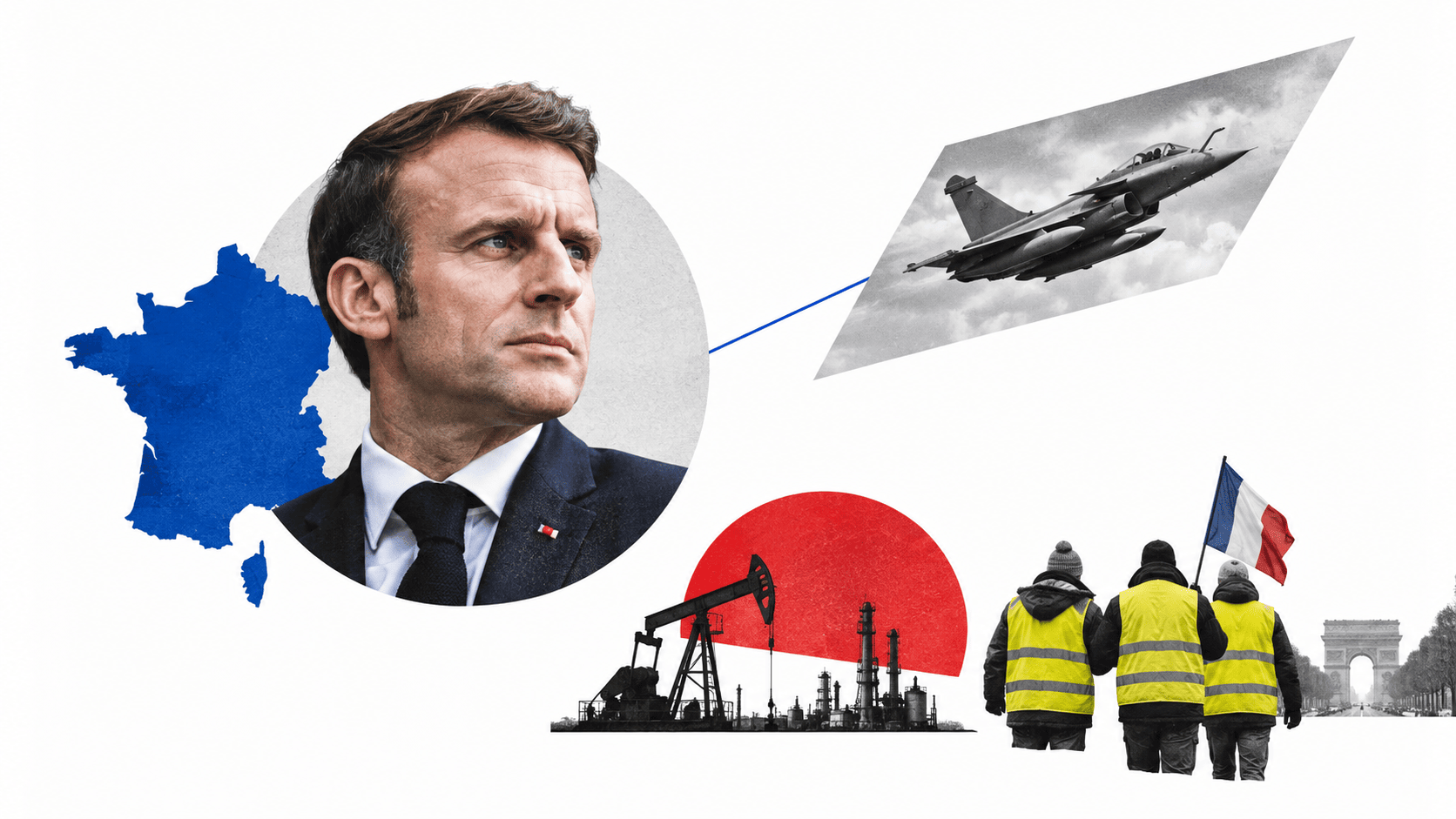
French President Emmanuel Macron brought party leaders and presidential contenders together at the Élysée Palace on 18 September. Military and intelligence officials also attended the meeting, which focused on the implications of the wars in Ukraine and the Middle East for France’s security and energy supplies. The aim was to give political leaders access to information available to the president.
The timing is significant. With the 2027 presidential election approaching, the government’s plans for around €54 billion in fiscal consolidation are provoking fierce debate. Briefing political leaders on national security ahead of the budget discussions due to begin in October highlights the increasingly close connection between economic choices and foreign policy.
Macron’s real test is managing external threats and the cost-of-living crisis at home
France’s central dilemma is that its security needs are growing just as its economic and social resilience is coming under strain. External threats demand higher defence spending, while the rising cost of living at home is driving calls for more support. The government must reconcile both demands with its commitment to reducing the budget deficit.
On security, relations with Russia are a defining concern. When Macron declined to rule out sending Western troops to Ukraine in February 2024, Putin responded with a warning about the risk of nuclear conflict. In June that year, Lavrov said that French military instructors deployed to Ukraine would be considered targets by Russian forces. These exchanges showed that the dispute between Paris and Moscow had escalated to the point where direct confrontation was being openly contemplated.
Energy, meanwhile, brings distant conflicts into the daily lives of people in France. Nuclear power gives the country a substantial advantage in electricity generation, but domestic oil and natural gas production is minimal. France imports most of the oil and gas it needs for transport, heating and industry. Diversifying suppliers therefore offers no insulation from rising international prices.
Disruptions to energy production in the Gulf or shipments through the Strait of Hormuz would affect more than just countries buying directly from the region. A tighter global supply could also push up the price of alternatives. For France, the challenge is not simply securing oil and gas, but obtaining them at prices households and businesses can afford.
This pressure comes at a time of economic stagnation. According to detailed figures from INSEE, the French economy contracted by 0.2% in the first quarter of 2026 and recorded no growth in the second. Household purchasing power, adjusted for household size, also fell by 0.6% in the second quarter. These figures help explain why another energy shock cannot be treated solely as a foreign policy issue.
A heavy debt burden and the need to bring down the deficit further constrain the government’s room for manoeuvre. Defence spending, debt interest, public services and measures to ease the cost of living all compete for resources within the same budget. Spending cuts can consequently provoke resistance among the very groups whose need for support is growing.
France’s recent history is a reminder of the political consequences of rising fuel prices. The Yellow Vest movement, which began in November 2018, showed how anger over fuel costs and a planned tax increase could quickly develop into a wider crisis over living standards and political representation. Today, the combination of rising energy prices and spending cuts could fuel a fresh wave of public discontent.
The Élysée meeting can therefore be read as more than a briefing on external threats. It can also be understood as an attempt to establish a sense of shared political responsibility for managing the domestic consequences of these crises.
France’s predicament raises a broader question about Europe’s future: can governments increase defence spending while preserving their societies’ economic resilience? The competing demands of energy costs, social spending and rearmament could intensify similar debates elsewhere in Europe, albeit to varying degrees.
Europe’s real test in this new era will be to strengthen its defences while keeping diplomatic channels open, and to bear the cost without making it harder for people to make ends meet. France’s experience today shows just how difficult that balance is to strike.