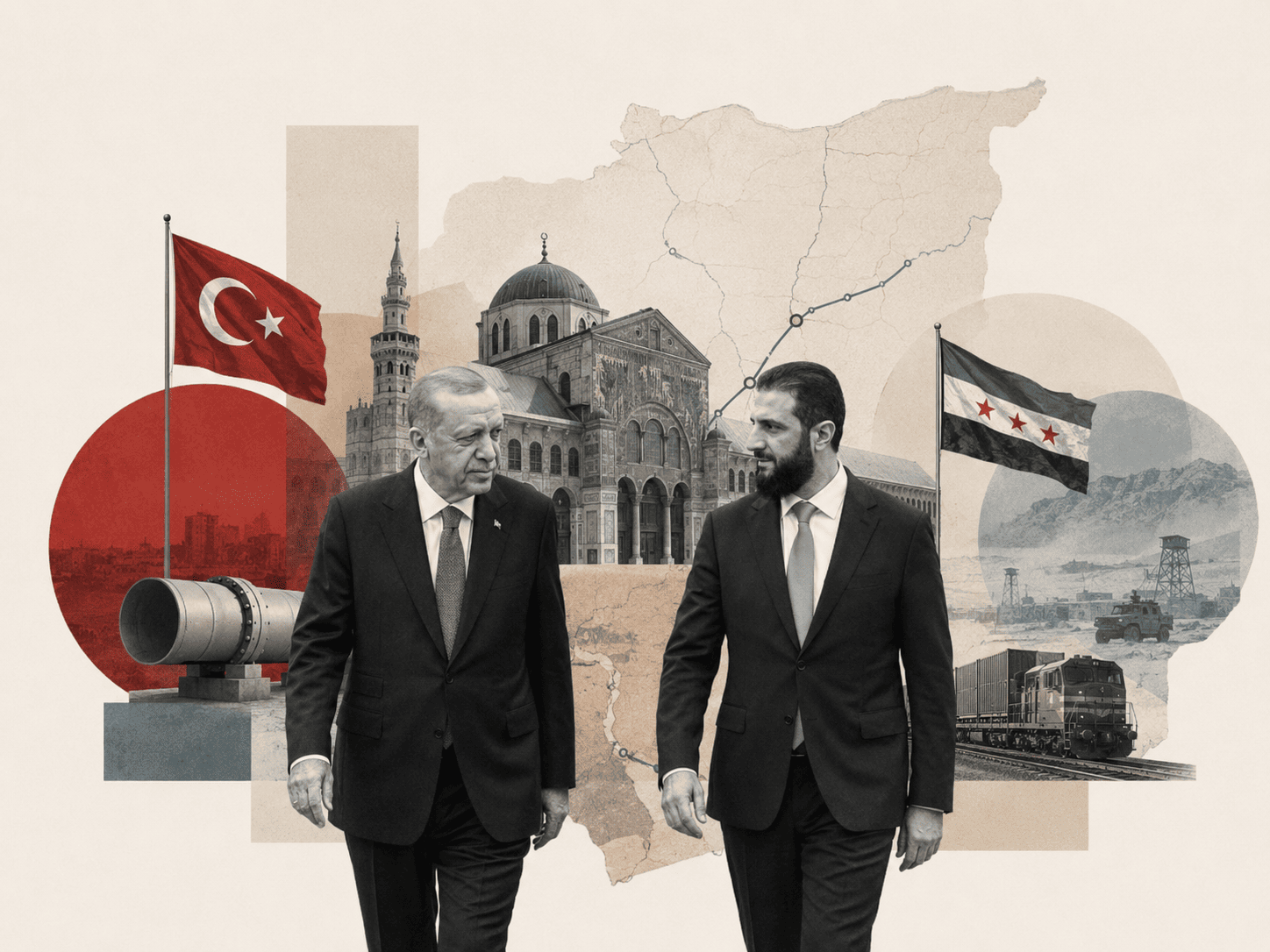

President Recep Tayyip Erdoğan’s long-discussed visit to Damascus is once again on the agenda. Türkiye’s Ambassador to Damascus, Nuh Yılmaz, has said that previously planned high-level contacts were postponed because of regional developments, adding that he expects Erdoğan to travel to the Syrian capital before the end of 2026. Yılmaz’s remark that the image of President Erdoğan walking alongside Syrian President Ahmed al-Sharaa at the Umayyad Mosque would “announce to the world the strength of the strategic partnership between the two countries” suggests that such a visit would carry significance far beyond that of a routine diplomatic engagement.
For Türkiye, Syria is not simply another neighbouring country. A shared border of more than 900 kilometres means that virtually every security crisis inside Syria has direct repercussions for Türkiye. Throughout the civil war, Türkiye hosted millions of Syrians, endured attacks by ISIS, confronted the presence of the PKK/YPG along its southern frontier and conducted direct military operations in northern Syria. The fall of the Assad regime in December 2024 therefore represented not merely a change of government in Damascus, but one of the most consequential turning points in a Syria policy Ankara had pursued for nearly fifteen years.
Türkiye’s role in the developments that ultimately led to the regime’s collapse also deserves particular attention. For years, Ankara was one of the principal backers of the Syrian opposition, established a significant military and political sphere of influence in the north and helped shape the strategic environment in which the forces that eventually overthrew Assad were able to operate. Even Donald Trump, speaking after Assad’s fall in December 2024, argued that Türkiye had effectively gained a dominant position in Syria and that the “key” to the country’s future would be in Turkish hands. In April 2025, he went further, saying that Erdoğan had effectively “taken over Syria” through proxies.
One of Ankara’s foremost priorities in the post-Assad era is to bring the issue of the Syrian Democratic Forces (SDF) to a definitive conclusion. Türkiye views the continued existence of the SDF, whose backbone is formed by the YPG, as an autonomous armed structure as a threat both to its own national security and to Syria’s territorial integrity. Ankara’s preferred approach today, however, is no longer limited to cross-border military operations. It increasingly rests on the restoration of central government authority across Syria and the integration of the SDF into state structures. From Ankara’s perspective, a strong government in Damascus would create the conditions for the lasting elimination of the PKK/YPG threat on both sides of the border.
Yet Türkiye’s emerging vision for Syria now extends well beyond security. Trade between Ankara and Damascus is expanding rapidly, while the reopening of border crossings, the restoration of railway links, the construction of energy infrastructure and the integration of Syrian ports into regional trade networks are all under discussion. Against this backdrop, the renewed emergence in recent months of the “Four Seas Initiative” gives these developments a broader geoeconomic significance.
The initiative seeks to connect the Persian Gulf, the Caspian Sea, the Black Sea and the Mediterranean through Syria and Türkiye, bringing energy pipelines, railway networks, ports, electricity interconnections and trade corridors together within a single geoeconomic architecture. Syria’s official news agency SANA has likewise presented the initiative as a project capable of transforming the country into a bridge linking the Gulf, Iraq and Central Asia with Türkiye and Europe. Its ambition is clear: to transform Syria, once at the epicentre of war, into a hub for trade and energy.
President Erdoğan Could Finally Fulfil His Pledge to “Pray at the Umayyad Mosque”
What gives a potential Erdoğan visit to Damascus its deepest symbolic resonance, however, are remarks he made in 2012. At the time, Erdoğan declared that he would go to Damascus, visit the tomb of Saladin and “pray at the Umayyad Mosque”. For years, those words were repeatedly invoked by critics of Türkiye’s Syria policy. Were Erdoğan now to travel to Damascus, they would acquire an entirely different political meaning.
A photograph of Erdoğan and al-Sharaa standing side by side at the Umayyad Mosque would therefore represent far more than the fulfilment of a promise made years ago. For Ankara, it could become the symbolic expression of the political, military and economic influence Türkiye has accumulated in post-Assad Syria.
It is precisely at this point that the second major dimension of the Syrian file comes into view: Israel.
With Iran losing much of the influence it had exercised in Syria under the Assad regime, Türkiye has moved to fill part of the resulting vacuum. Israel, meanwhile, has also sought to expand its own strategic footprint. While maintaining control over the Golan Heights, occupied since 1967, Israel moved after Assad’s fall into the buffer zone established under the 1974 disengagement agreement and into strategically important positions on the Syrian side of Mount Hermon. The United Nations has stated that these moves are inconsistent with the 1974 agreement.
As a result, the contrasting visions held by Türkiye and Israel for Syria’s future are becoming increasingly visible. Ankara wants a Syria with a strong central authority, a reconstituted national army, preserved territorial integrity and growing integration into the global economy through Türkiye. Israel, by contrast, views the emergence immediately to its north of a powerful military structure supported by Ankara as a potential security threat.
These concerns have already translated directly onto the ground. Reuters reported in April 2025 that Israel had struck military facilities at T4, Palmyra and Hama that Turkish military teams had assessed for possible future deployment. The fact that Türkiye and Israel subsequently opened technical talks aimed at preventing an unintended direct confrontation in Syria underscored how seriously both sides viewed the risk.
A new report in the Israeli media on 15 August brought this rivalry back into focus. According to Channel 13, as Türkiye sought to strengthen its military and strategic position in Syria, Israel approached Washington several weeks earlier seeking approval for a new strike against targets linked to Türkiye. The Trump administration, however, reportedly declined to authorise the operation.
If Erdoğan’s visit to Damascus takes place, a photograph at the Umayyad Mosque would therefore do more than close a symbolic chapter dating back to the early years of the Syrian war. It would also project to the world the extent to which Türkiye has emerged as one of the most powerful external actors shaping Syria’s new order.
Yet that image could also mark the beginning of a much larger question: as Türkiye moves into the strategic space left behind by Iran’s retreat from Syria, how far will Israel be prepared to accept this new balance of power? And is Syria becoming the next major arena in a broader regional contest for influence between Ankara and Tel Aviv?