
Israel’s 18 August strike on the Abu al-Duhur airbase in northern Syria initially appeared to mark another escalation in the intensifying rivalry between Türkiye and Israel over Syria. Yet subsequent remarks by Tom Barrack, the US ambassador to Türkiye and special envoy for Syria and Iraq, suggested that the episode carried far broader implications. Barrack did more than criticise the Israeli operation: he questioned its rationale, stated that US authorities had not corroborated the intelligence on which Israel relied, and even raised the possibility that Türkiye had been deliberately provoked.
Understanding the significance of the episode requires first examining the sequence of events.
Several days before the strike, Israel informed both Washington and Damascus of its concerns that Türkiye was preparing to deploy military personnel and advanced weapons systems to Abu al-Duhur. According to Reuters, Mossad director Roman Gofman spoke directly with Syrian foreign minister Asaad Hassan al-Shaibani on 14 August to discuss Turkish military activities in Syria. Syrian officials maintained that no permanent Turkish base was being established at Abu al-Duhur and that there had been no Turkish military build-up. A further meeting was scheduled for the following week.
Israel nevertheless proceeded with the operation on the morning of 18 August. Syrian state media reported that the airbase’s runways and hangars were targeted in at least eight airstrikes. Although there were no casualties, recently repaired runways sustained damage. The facility lies approximately 70–80 kilometres from the Turkish border. Israel initially declined to acknowledge responsibility. Around 20 hours later, however, Prime Minister Benjamin Netanyahu’s office confirmed the operation, arguing that Syria was preparing to violate what Israel described as an agreed ‘security status quo’ by allowing Türkiye to deploy forces at the site.
Türkiye rejected that account. Ankara maintained that there had been no Turkish military deployment of the kind alleged by Israel. Al-Shaibani subsequently told Axios that reconstruction work at the airbase was being undertaken for the Syrian air force and that neither a permanent Turkish military presence nor the establishment of a Turkish base was envisaged. Visits by Turkish military officials, he said, had taken place within the framework of existing training arrangements and military cooperation between Türkiye and Syria.
It was against this backdrop that Barrack intervened. In his initial statement on 18 August, he described the Israeli operation as an ‘unnecessary escalation that does not serve regional stability’. Speaking to Reuters, he said that Türkiye had not been notified in advance and that Turkish officials, observing Israeli aircraft flying north, ‘could reasonably have prepared a military response’. Washington, he added, would seek to establish a more robust deconfliction mechanism among Türkiye, Israel and Syria.
The details Barrack provided to PBS NewsHour on 21 August, and subsequently to Mario Nawfal, were even more striking. He explained that Israel had shared intelligence alleging that Türkiye was moving military assets to Abu al-Duhur, but that a review by US intelligence agencies had failed to substantiate the claim. According to Barrack, the Syrian government had also informed Mossad that there were no Turkish military convoys or offensive Turkish weapons systems in the area. Diplomatic discussions, moreover, were still under way.
Barrack consequently advanced two highly unusual explanations for the strike. The first was that Israel might have deliberately sought to provoke Türkiye, potentially for domestic political reasons ahead of the forthcoming Israeli elections. The second was that serious coordination failures had occurred among Mossad, the Israeli military and the country’s political leadership. In effect, Washington’s Syria envoy was suggesting that Israel had either engaged in a calculated provocation against Türkiye or failed to ensure an adequate flow of information among its own state institutions.
On 20 August, the Israeli news outlet Ynet published an analysis of Barrack under the provocative headline ‘Erdoğan’s man?’ One Israeli official described him as someone perceived to be advancing the interests of President Recep Tayyip Erdoğan and the Syrian government in Washington. Another senior official said Netanyahu disliked Barrack and regarded him as one of the principal figures behind President Donald Trump’s support for Syrian president Ahmed al-Sharaa.
Israel’s unease with Barrack, however, reflects a disagreement that extends well beyond any perceived personal affinity with Erdoğan. In Barrack’s regional framework, Türkiye is not a threat to be excluded from Syria’s reconstruction or the Middle East’s emerging security architecture, but a major actor with which the United States must cooperate. He supports Syria’s reintegration into the regional order, the revival of its economy, stronger relations between Ankara and Damascus, and the resolution of Israeli–Syrian disputes through negotiation rather than military force. His openness to Türkiye potentially rejoining the F-35 programme has further intensified concern in Israel. As Israeli officials quoted by Ynet suggested, Barrack’s principal offence is not hostility towards Israel, but his refusal to view the region exclusively ‘through Israel’s eyes’.
The accusation that Barrack is ‘Erdoğan’s man’ therefore exposes a deeper Israeli anxiety: that Washington may increasingly regard Türkiye not as Israel’s regional rival, but as an indispensable strategic partner in its own right.
US–Israeli Interests Are Increasingly Diverging
Barrack’s remarks raise a broader question: is a deeper strategic divergence emerging between the United States and Israel?
According to Axios reports citing US officials, disagreements between Trump and Netanyahu have intensified markedly over the past three months across several issues, including Iran, Gaza, Lebanon and Syria. Trump is reportedly frustrated by some of Netanyahu’s decisions and has avoided offering the unequivocal political support the Israeli prime minister had anticipated ahead of the forthcoming elections. Sources close to Trump maintain that, although the US president continues to like Netanyahu personally, he has become increasingly dissatisfied with his policies.
Syria is perhaps the clearest illustration of this divergence. In July, Trump told Netanyahu that Israeli forces should begin withdrawing from certain areas in Syria and Lebanon. The US administration regards the stabilisation of al-Sharaa’s government in Damascus, a security agreement between Syria and Israel, and Syria’s reintegration into the regional order as potentially significant foreign-policy achievements for Trump. Netanyahu’s government, by contrast, seeks to preserve the Israeli military’s freedom of action in Syria and, in particular, to constrain Türkiye’s expanding military influence.
A similar pattern is evident in Gaza. On 9 August, Netanyahu declared unacceptable the Trump administration’s 15-point proposal, which envisaged the disarmament of Hamas and a phased Israeli withdrawal. Trump adviser Jared Kushner subsequently travelled to Israel for a four-hour meeting with Netanyahu, urging him to give Washington’s proposal a chance. A few days later, Trump publicly called on Israel to halt its attacks in Gaza.
None of this suggests that the US–Israeli alliance is unravelling. Something else, however, is changing, and it may ultimately prove more consequential: Washington is becoming less willing to equate its interests in the Middle East entirely with Israel’s perception of its own security.
The Trump administration wants stability in Syria, an end to the war in Gaza, a new regional arrangement involving Saudi Arabia, strong relations with Türkiye and greater economic integration. Netanyahu’s government, influenced in part by the approaching elections, favours broader military freedom of action, a more assertive security posture and constraints on Türkiye’s growing influence in Syria. One side is attempting to rebuild the regional order through negotiated arrangements; the other continues to pursue security primarily through military superiority.
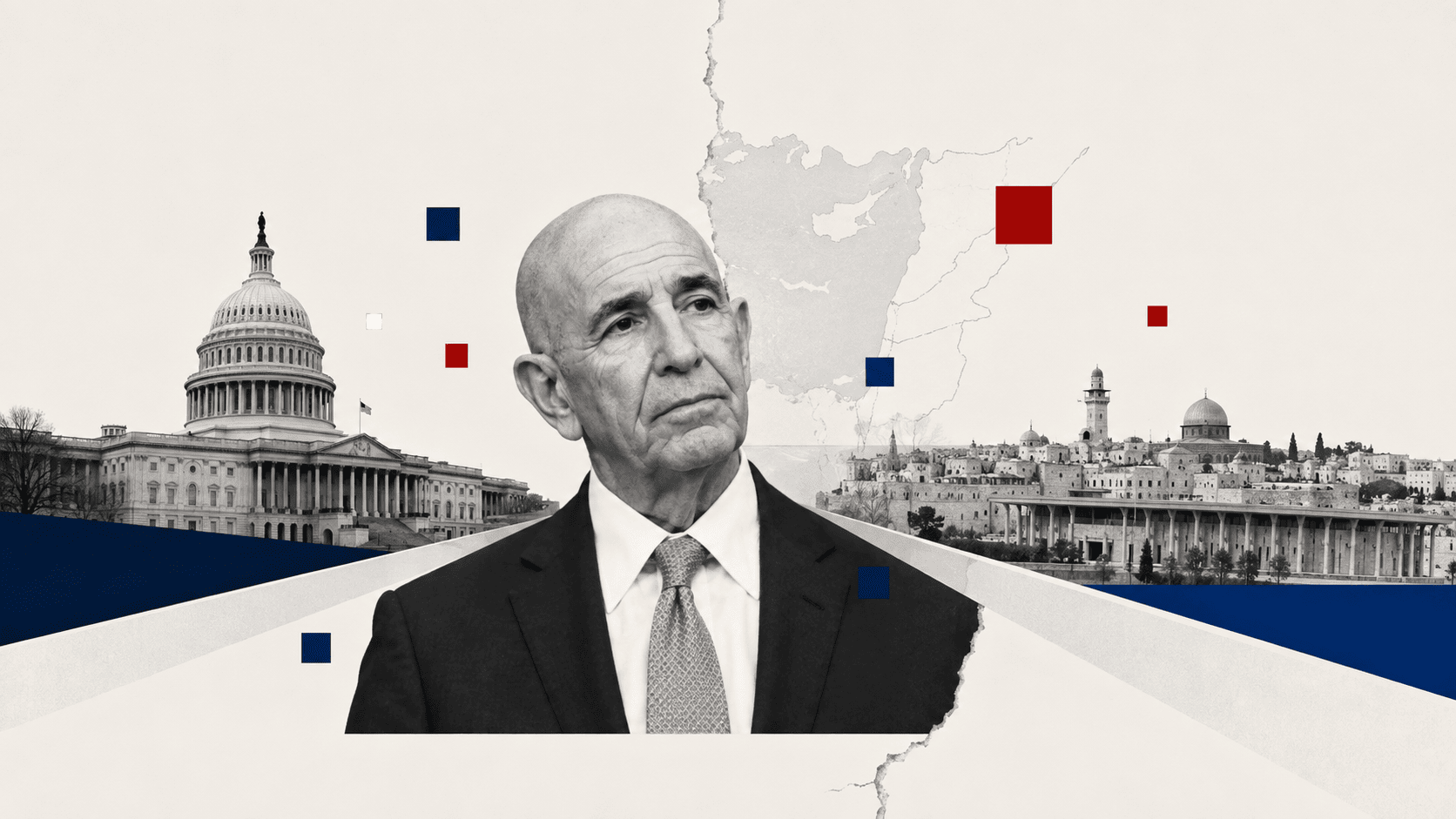
Tom Barrack has become one of the most visible embodiments of this divergence.
More broadly, he represents the Trump administration’s emerging approach to the Middle East: a more pragmatic system in which traditional alliances are no longer sufficient on their own and in which the interests of Türkiye, Syria, the Gulf states and Israel must be balanced within a shared strategic framework.
What truly unsettles Israel is precisely this possibility: that Washington’s Middle East policy may no longer revolve around Israel alone, and that a new regional equation is emerging in which other actors are increasingly recognised for their own strategic weight.