
In recent years, speculation has grown that Türkiye could develop nuclear weapons, or at least keep such an option on the table.
Iran’s nuclear program, Israel’s de facto nuclear capability, the nuclear threat rhetoric frequently used by Russia during the war in Ukraine, and the fractures in the global security architecture have brought this debate back to the forefront.
The ambiguous answer given by Turkish Foreign Minister Hakan Fidan to a question on this issue was analyzed for days in the international media.
But is the real question truly whether Türkiye should or should not possess nuclear weapons?
In my view, it is not.
Because this debate overlooks a far more important issue: why does the international system consider it legitimate for some countries to possess nuclear weapons, while treating the same security pursuit by others as illegitimate?
Today, nine countries are known to possess nuclear weapons. The United States, Russia, China, France and the United Kingdom are recognized under international law as “legitimate nuclear powers,” while India, Pakistan, North Korea and, de facto, Israel have also joined this club later on.
The world has been living with this contradiction for nearly eighty years.
On the one hand, nuclear weapons are described as an existential threat to humanity. On the other, the indefinite possession of these weapons by certain states is considered natural and necessary. Yet when another country seeks to acquire the same capability, it is immediately regarded as a threat to global security.
At this point, an unavoidable question arises: If nuclear weapons are truly a threat to humanity, why are they not banned for everyone? If they are indispensable for deterrence, why do they remain the monopoly of only a handful of countries?
This is precisely where the injustice at the heart of the nuclear debate lies.
The paradox of nuclear weapons is that their real power does not come from their use, but from the deterrence created by the very possibility that they could be used.
Today, no one seriously discusses the possibility of directly defeating Russia militarily. The reason is not Russia’s economic power, but the thousands of nuclear warheads it possesses. Similarly, the North Korean regime, despite being subjected to some of the world’s harshest sanctions, owes its survival largely to its nuclear capability.
According to some experts, even the fact that Iran does not yet officially possess nuclear weapons does not prevent it from generating a certain level of deterrence. Strategic power does not always lie in the weapon one actually possesses, but sometimes in the ambiguity created around the possibility of acquiring it.
For this reason, nuclear weapons function less as a conventional military tool than as a political and psychological security insurance.
There are several reasons why Türkiye has found itself at the center of these discussions in recent years.
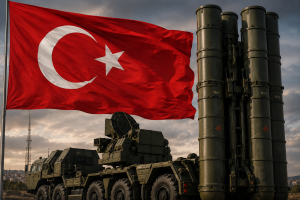
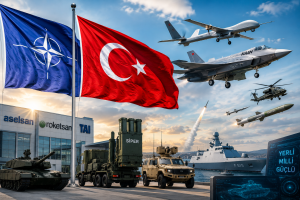
First, Türkiye is no longer merely a NATO border state as it was during the Cold War. It is a country developing its own defense industry, working on long-range missile programs, building a space program, and increasingly emphasizing the concept of strategic autonomy.
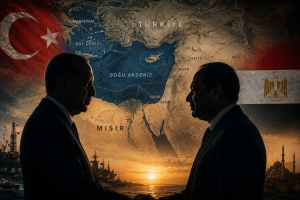
Second, Türkiye’s geographical environment has become more fragile than ever. To the north lies Russia, a nuclear power; to the south, Iran, often described as a nuclear threshold state; and in the region, Israel, widely regarded as a de facto nuclear power.
The third reason is the gradual erosion of trust in external security commitments. After the collapse of the Soviet Union, Ukraine gave up one of the world’s largest nuclear arsenals. In return, it received security assurances. Yet in 2014, it lost Crimea, and in 2022, it faced a full-scale war.
Similarly, Libya voluntarily abandoned its nuclear program. But that decision was not enough to guarantee the long-term security of the regime.
For many countries, these examples raise an unavoidable question: Do the promises made by great powers truly provide protection in times of crisis?
From a technical standpoint, it cannot be said today that Türkiye is close to developing nuclear weapons.
Türkiye has a history of nuclear research, trained human resources, the Akkuyu Nuclear Power Plant, and significant thorium reserves. However, it does not possess the capabilities required for nuclear weapons production, such as high-level uranium enrichment or plutonium separation.
More importantly, Türkiye is a party to the Treaty on the Non-Proliferation of Nuclear Weapons. The explicit launch of such a program could bring heavy economic sanctions, diplomatic isolation, and serious strategic costs.
Moreover, the issue would not be limited to Türkiye alone.
If Türkiye were to begin developing nuclear weapons, it would not be difficult to anticipate how Saudi Arabia, Egypt and other regional powers might react. Such a development could trigger a chain reaction of nuclear proliferation across the Middle East.
In my view, before debating whether Türkiye should or should not possess nuclear weapons, we need to ask a broader question: Is the real problem that Türkiye might want nuclear weapons, or that the world is still built on a system incapable of distributing security equally?
Because in a world where nuclear weapons exist, it is impossible to say that everyone is equally secure.
And perhaps this is precisely where one of the greatest strategic contradictions of the twenty-first century lies.